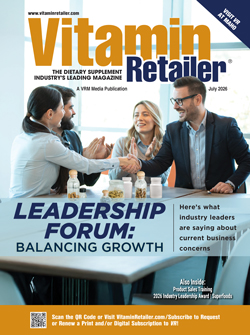



Here’s what industry leaders are saying about current business concerns.
The panel:
Alina Hornfeldt, Co-owner, Mastel’s Health Foods, St. Paul, MN, www.mastels.com
Jim Emme, Chief Executive Officer, NOW Foods, Bloomingdale, IL, www.nowfoods.com
Ramona Billingslea, Marketing & Education Manager, Betsy’s Health Foods, Spring, TX, https://betsyhealth.com
Steve Mister, President & Chief Executive Officer, Council for Responsible Nutrition (CRN), Washington, D.C., www.crnusa.org
Travis Lemon, Co-owner, Tulsi at the Market, Huntington, WV, www.tulsiwv.com
The natural products industry is seeing strong growth but also challenges relating to inflation and other headwinds. Emerging state and federal laws are changing the regulatory environment in various ways, with regulatory uncertainty continuing to be a major issue facing the VMS (vitamins, minerals and supplements) industry. The Iran war also appears to be contributing to a reduced consumer demand for supplements in the face of increased inflation, leading consumers to spend less. As global forces continue to shape the VMS market in various ways, retailers and supplement brands will need to be adaptable. Here’s what our panel of experts has to say about the current business concerns facing the VMS industry.
VR: What are your current business concerns?
Hornfeldt: Like many independent retailers, we’re focused on balancing growth with increasing costs and ongoing uncertainty. Labor, operating expenses, and maintaining competitive pricing continue to be important considerations. At the same time, there’s more noise than ever in wellness, so helping customers navigate trends and find products they can trust remains a major focus. Consumer trust and transparency have become increasingly important across the industry. Engaging customers in the real world as opposed to online has become a priority; we are leaning into ways to make in-store shopping memorable and enjoyable.
Emme: We are very concerned about how fuel prices will affect consumer spending globally. We are a value brand and do not frequently raise our prices, so we are also concerned about the cost impact of freight on our inbound supply chain costs.
Our current business is very strong, both domestically and in our international markets, so the inflationary impact of energy costs has not yet dampened our sales.
Billingslea: Foot traffic has been in a slow decline since June of last year. Since the war in Iran revved up, foot traffic has dropped considerably more. In the last few days, we have begun to see an uptick that we hope will continue. I believe that in Texas, foot traffic has decreased 17 percent in the retail space since January. We’ve visited other health food store owners who have experienced similar trends. We’re working on ways to bring people back in, as well as beefing up our online presence to meet people where they are.
Mister: From CRN’s perspective, the biggest concerns facing the supplement and functional food industry right now are policy and regulatory-related. We’re closely focused on the growing number of state-level product and ingredient restrictions, ongoing discussions surrounding FDA (U.S. Food and Drug Administration) oversight and implementation of DSHEA (Dietary Supplement Health and Education Act of 1994), and federal legislative proposals involving inclusion of supplements in FSAs/HSAs, federal preemption, and creation of a mandatory label registry.
One especially important issue is the pending Supreme Court appeal involving New York’s age-restriction law on certain dietary supplements. That case raises significant First Amendment concerns regarding a marketer’s ability to communicate truthful information and market lawful products to consumers. We’re also paying close attention to drug preclusion issues and the implications those policies may have for consumer access and future ingredient innovation. More broadly, the industry is increasingly concerned about the emergence of a patchwork of state-by-state requirements that could create inconsistent standards nationwide and make compliance substantially more difficult for responsible companies.
Lemon: We are pretty concerned about the upcoming federal hemp ban that is coming up in November. It will definitely affect THC-forward hemp supplements and drinks, but if nothing is changed, it will also effectively ban most CBD supplements, including the full-spectrum CBD formulas that many of our customers depend on. I know some great industry folks are working to delay and repeal this upcoming hemp ban and I certainly hope they succeed.
VR: What sorts of products are trending right now?
Hornfeldt: We’re seeing strong interest in functional wellness products such as adaptogens, medicinal mushrooms, gut health support, protein-focused products, and longevity ingredients. Customers are looking for products with specific benefits and science-backed results rather than broad and dramatic wellness claims. Some things that have been big topics industry-wide are finally beginning to catch on with our customers here in the north.
Emme: We are seeing growth across our wide array of SKUs. Our sales of magnesium products continue to increase, and we still see creatine demand holding steady.
Billingslea: Collagen, probiotics, bone health and CoQ10 all continue to be popular products. Customers are increasingly interested in the supplements targeting vitality. They are looking forward and striving to age well, not just supplementing for current imbalances and nutrient deficits. I’ve noticed more customers interested in peptides as well.
Mister: Broadly speaking, there continues to be strong consumer interest in areas like healthy aging, cognitive health, women’s health, sports nutrition, and personalized wellness, but we generally defer to data and analytics organizations for detailed market trend reporting.
Lemon: Mushroom supplements of all forms are still doing great for us. I’ve noticed an uptick in hair, skin and nail support products for women and men alike. Adrenal support and inflammatory support supplements are holding steady for us as well.
VR: How are tariffs affecting the natural products industry?
Emme: The tariff impacts have settled, and they are not nearly as volatile as they were this time last year. The current focus is on companies that are beginning to apply for IEEPA refunds to claw back the costs of tariffs. We have held several meetings with the White House through the Natural Products Association (NPA) to gain better visibility into where the tariff situation is headed.
We continue to benefit from the relief we have gained from the Annex II status the White House granted many of our ingredients on April 4, 2025. This has saved our industry and consumers hundreds of millions of dollars in tariff costs. We all need to be grateful that NPA facilitated the successful recognition of these ingredients on the Annex II list.
Billingslea: Some of our out-of-stocks may be due to the tariffs or the unrest around the world. The main impact we’ve noticed is that everyone seems to be going up on prices. Some of those price changes are huge jumps, up to eight or nine dollars. It’s forcing us to cut into our margins to keep prices within a reasonable range. We need customers to keep buying, after all, especially since people are buying less now that prices have gone up everywhere.
Mister: We are hearing from our members that the tariff situation has had a significant impact on their businesses. The unpredictability of the changes over the past year have disrupted supply chains and made it more difficult to develop business plans and introduce new products. In general, any policies that increase costs or disrupt ingredient sourcing can create additional pressure through the manufacturing and distribution process.
Lemon: We’ve had some brands raise prices, and we’ve noticed more out-of-stock issues with quite a few categories, which we assume were caused by new and larger tariffs.
VR: What can you add about the natural products supply chain right now?
Emme: The natural products supply chain is steady regarding ingredient availability. The main area of concern is the quality of ingredient samples we receive from vendors. We all need to be vigilant in performing the proper screening of inbound raw materials for quality and ID testing, especially with botanicals.
Billingslea: Our out-of-stocks are down this year, so I think that if there are any supply chain issues, our manufacturers are doing a great job forecasting potential shortages and buying so that they don’t run short.
Lemon: More out-of-stock products for sure, but some products that we’ve had trouble getting have started to become available in the last few weeks.
VR: What emerging trends are happening with respect to supplement pricing?
Hornfeldt: Customers still value quality, but they’re becoming more intentional with spending. We’re seeing demand for products that offer multiple benefits or stronger perceived value. Brands are also working to justify pricing through clinical research, branded ingredients and transparency rather than competing on price alone.
Emme: We see some prices rising this year, but not so much due to tariff issues. The cost problems are more related to the cost of fuel for transport.
Billingslea: Almost every manufacturer we carry is increasing their prices. A few items have gone down in price, but they are a very small minority. Until gas prices come down again, we’re stuck with inflation.
Lemon: Quite a few brands have increased their prices; hopefully we’ll see that brands start lowering their prices or at least run more aggressive promos now that some of those tariffs have been overturned and refunds to importers are starting to roll out.
VR: What sorts of trade associations and trade shows are you participating in?
Hornfeldt: We stay actively involved in the natural products community through key trade shows and educational events. Industry gatherings are valuable because they help us discover emerging brands, stay current on trends, and build relationships that ultimately benefit our customers and our business. We are members of INFRA, and we are on the Emerging Leaders Council of SENPA. We love the SOHO show and attend Expo West and Newtopia as well. The INFRA show is right here in Saint Paul, and we love showing off all our city has to offer. We also attend the KeHe Summer Show and find a good deal of value in keeping up with what’s in our D.C. And we are looking forward to seeing the Positively Natural show grow.
VR: What kinds of state and national issues are affecting the industry right now?
Hornfeldt: Regulatory uncertainty continues to be a major issue. We’re seeing a growing patchwork of state regulations, ongoing conversations around ingredient oversight, labeling requirements, and evolving standards around product claims and transparency. Keeping up with changing regulations has become increasingly complex for both retailers and brands. We just try to ride each wave as it comes.
Emme: The states are very active regarding attempting to implement new laws, which is the responsibility of the FDA. The weight-loss law in the state of New York is the most well-known of these, and there have been copycat laws for weight-loss supplements that have been attempted in more than 17 states so far in recent months. There have also been Prop 65-style proposed laws showing up in several other states. We are vigorously advocating for a federal pre-emption bill that will override the authority of the states to produce their own rules that are currently the responsibility of the FDA.
Billingslea: I read an article the other day that said even though people are getting raises, they still can’t keep up with the rising cost of living. I think the economic factors are the main issues affecting our industry, on the state and national level.
Mister: At the state level, multiple bills that would prohibit certain ingredients, require additional disclosure or labeling, or restrict sales of products to those over 18 all create inconsistent regulatory frameworks from one state to another. Nationally, there continues to be substantial discussion around FDA modernization and implementation of DSHEA, as well as proposals involving federal preemption that are intended to preserve a consistent national framework for dietary supplement regulation.
The industry is also closely watching the pending Supreme Court appeal involving New York’s supplement age-restriction law, which raises broader First Amendment concerns regarding companies’ ability to communicate truthful information and market lawful products to consumers. In addition, drug preclusion remains an important issue, particularly questions surrounding FDA’s use of the drug preclusion provision to limit the availability of certain dietary ingredients that have long been marketed as supplements. Collectively, these issues have significant implications for consumer access, regulatory consistency, innovation, and the ability of responsible companies to operate effectively nationwide.
Lemon: I think that there is a lot more predatory marketing of supplements than there has been in quite a long time. I suspect this is mainly due to this administration’s lax enforcement and embrace of many conspiratorial ideas themselves. In my opinion, those types of fearmongering tactics only serve to make the industry look bad. Hopefully something changes in that respect, be it better enforcement of blatantly non-compliant health claims on social media platforms, or a public shift toward researched products and away from too-good-to-be-true claims. At Tulsi, we have stayed away from brands with misleading claims and fad supplements that we don’t think belong on the shelves of a natural products store, and plan to continue that practice.
VR: Is there anything else you wanted to say?
Emme: There is another effort underway to approve a bill supporting a master products list that is being remarketed under different names, including the use of a silly AI-generated cartoon character by one of the industry trade groups. The Master Product List bills have been blocked at least four times in the last several years and will likely be blocked again this year. We believe it is just a precursor to a pre-market approval system for dietary supplements. It’s a solution looking for a problem, and the FDA stated several weeks ago that a master product list is not a priority for them this year. It’s a frivolous bill that does nothing for consumers or industry. We believe that these wasteful efforts would be better served if more companies in our industry did testing and exposed fraudulent products. We are doing this with our testing of bad products being sold on various online platforms.
Billingslea: I think the rapid growth of AI will influence the way we do business. For now, it has been a benefit in that we’re able to use it inside our Shopify platform to help us get more done with less work on our part. It’s also making it easier to get more specific support answers when we have a problem with that platform. The downside is that more people may depend on AI answers to choose their supplements, but I don’t have confidence in AI doing as good a job as a real person, educated on products, helping a customer face-to-face. There is an intuitive factor to helping people pick out the supplements they need that AI cannot accomplish.VR