


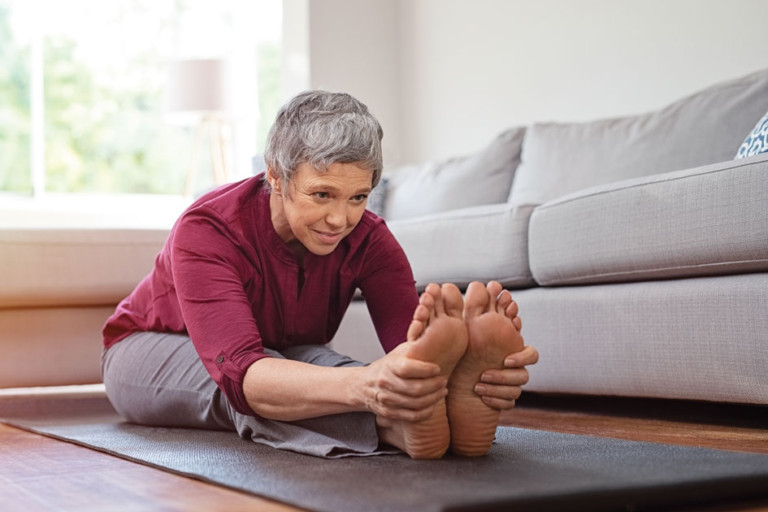
I heard a “mature” comedian talk about the problems of bending down. She said that if she actually has to pick something up off the floor, she waits until something else drops so she can pick them both up at the same time. “You think I’m bending all the way over to pick up a spoon?” The audience responded with appreciative laughter. Likewise, a friend, who had just resumed working out with her personal trainer the day before and hurt all over, asked me to pick something up that she had dropped. “I would, but it’s too far down!” she bemoaned. I don’t know about you, but I resonated with both these scenarios. We take flexibility and easy movement totally for granted—until it disappears. I went from downward facing dog and warrior pose to thinking twice about wearing shoes with shoelaces (too far down!)
As we age, our risk for joint and muscle pain and problematic flexibility escalates. There are several reasons for this, including bone erosion, water loss in the spinal discs and joints, tendon and ligament shortening/stiffening, collagen loss, decrease in lubricative factors and chronic inflammation. There is also an increase in diseases that inhibit flexibility as we age, including one of the most common, osteoarthritis.
Before we start to discuss supplements that can improve flexibility and comfortable movement, I have to note that the single most important thing you can do is to keep moving. Walking, stretching, tai chi, yoga, swimming or whatever you are motivated to do, keep doing it. You cannot out-supplement a completely sedentary lifestyle.
Nutrients That Make a Difference
Collagen is an important protein family, and type II collagen makes up about 90 percent of our joint cartilage. Unfortunately, collagen starts to diminish starting around age 25, so the older we get, the more challenging it is to make sure our joint and connective tissue is getting what it needs. Supplementing with type II collagen can make a real difference, but there are two forms that work in very different ways: hydrolyzed and native.
Hydrolyzed type II collagen is broken down, or predigested, so that it is easily absorbed as a building block that the body can use to increase its store of this important protein. It works especially well when combined with two other building blocks, glucosamine and chondroitin. In a six-month human clinical trial, scientists found that combining type II collagen with glucosamine and chondroitin improved symptoms of hand osteoarthritis much better than those just using glucosamine and chondroitin alone. The researchers also noted that those receiving the extra boost from type II collagen improved faster and more steadily over the year with further improvements and better symptom relief.
Native type II collagen is not hydrolyzed. It is not absorbed into the body to act as a building block. It serves a unique role in desensitizing the body to this form of collagen. When we have joint damage and inflammation, our immune system wants to get rid of the problematic tissue. This sets in motion a chronic process of tissue destruction in a self-defeating cycle. The more the immune system acts to remove the inflamed cartilage, the more cartilage is damaged and inflammation increases.
There is an area of immune system cells in the intestines called Peyer’s patches. Peyer’s patches are like hall monitors looking for trouble makers. If we encounter harmful substances, the Peyer’s patches send a warning and the immune system responds.
When people use native type II collagen, they expose the Peyer’s patches to type II collagen two or three times a day. The patches become desensitized to collagen, and this is signaled to the immune system. The immune system then becomes desensitized and pulls back from attacking and degrading the collagen in the joints and connective tissue. In essence, it puts out the fire so that the inflamed areas can heal and start to rebuild.
In one clinical study, native type II collagen was used alongside acetaminophen (one brand name is Tylenol) and tested against acetaminophen alone in two groups of volunteers with osteoarthritis. The group using type II collagen definitely came out ahead—they had significantly less knee pain, better knee flexibility, and better walking scores.
Glucosamine and chondroitin are incredibly useful building blocks to build and maintain strong, flexible joints. Both glucosamine and chondroitin strengthen cartilage, reduce inflammation and pain, and chondroitin strengthens the bones in joints. Using them in conjunction is generally more effective than using either in isolation.
In the body, glucosamine is a compound called a polysaccharide that is naturally found in cartilage. Using glucosamine is especially useful in rebuilding the shock absorber parts of the joints, which in turn over time relieves pain, too.
Chondroitin is a glycosaminoglycan (GAG) which is a direct building block of cartilage, connective tissue, bone and skin. Use of chondroitin can extend the life and even increase the activity of the cells in the joints that make cartilage. Studies have shown it reduces inflammation, and strengthens the load-bearing bones in the joints that sit just under the cartilage, called “subchondral” bone.
A six-month clinical study compared the combination of glucosamine and chondroitin to the generic prescription drug celecoxib (one brand name is Celebrex). The glucosamine/chondroitin combo worked as well as the drug, with about a 50 percent reduction in pain, swelling, fluid around the joints, and other knee osteoarthritis symptoms. However, the glucosamine/chondroitin group did not have the risks of the drug group, such as intestinal upset, reduced kidney function and significantly increased risk of heart attack and stroke.
Hyaluronic acid is another crucial component of collagen, cartilage and joint lubricative fluid. It helps lubricate the shock absorbers in your joints and spine to increase flexibility, reduce pain and improve mobility. In a human clinical trial, a high-quality hyaluronic acid supplement improved muscle aches and joint pain by 75 percent in just eight weeks.
In another three-month study, hyaluronic acid was shown to relieve muscle pain and reduce synovial fluid pooling in knees. Interestingly, it helped regenerate muscle, too.
Boswellia, specifically Boswellia serrata, is an herb with proven effectiveness for reducing joint-specific inflammation and the damage that inflammation causes to both cartilage and bone. It is one of the few effective ways of stopping 5-LOX (5-lipoxygenase) inflammation, which is an inflammatory pathway associated with osteo and rheumatoid arthritis, gout and psoriasis/psoriatic arthritis.
In addition to reducing 5-LOX, boswellia actually inhibits certain cartilage-destroying enzymes. Therefore, it doesn’t just stop pain, it stops the actual progression of damage in joints and muscles. Unlike conventional prescription or over-the-counter drugs, it isn’t masking anything—it’s healing the joints.
Not all boswellia is created equal. The most powerful anti-inflammatory compound in boswellia is called acetyl-11-keto-B-boswellic acid (AKBA). In the majority of research studies on boswellia, AKBA is cited as the heavy lifter to relieve pain, reduce intestinal and lung inflammation, help protect the brain against stroke damage. Unstandardized Boswellia has as little as 1 percent AKBA. In order to have higher levels of medical efficacy, you need a minimum 10 percent standardization.
Boswellia also contains beta boswellic acid (BBA), which actually increases inflammation! Unstandardized boswellia has 20 to 25 percent BBA, which weakens the ability of the herb to ameliorate inflammation. Purified boswellia reduces BBA to less than 5 percent, which robustly improves the effectiveness of boswellia.
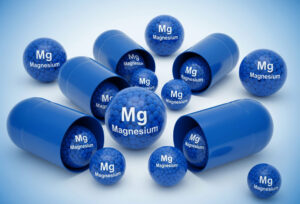
Magnesium is essential for tendon and ligament health, and is a cofactor in hundreds of enzymatic reactions throughout the body. It promotes muscle relaxation, which reduces both tightness and stiffness, and improves the flexibility of tendons; you don’t get that “tightness” from activity or more recurring concerns like carpal tunnel syndrome. If you are deficient in magnesium, you are much more prone to muscle cramps and numbness. It is a great partner to the B vitamins, especially P-5-P, the active form of B6.
Bioactive B vitamins are the methylated form of the Bs, meaning they are the same form as your body uses. Other B vitamins must be converted in the liver to be active, but that process declines with age and in the presence of certain diseases, such as diabetes. The bioactive form of vitamin B6 is pyridoxal-5-phosphate (P-5-P) and vitamin B12 is methylcobalamin. These two active Bs are essential for ligaments, tendons and flexibility. They work especially well when combined with a quality amino acid chelated magnesium.
The list goes on! There are even more nutrients that can be very useful for flexibility, including pancreatic enzymes, vitamin C, bromelain, manganese, curcumin, topical comfrey and others shown to make a real difference in your mobility. There are many natural supplements that can make a real difference in your life, but give them a while to do their magic—most need about three months to produce noticeable changes. Stick with it and you will be rewarded! VR
References:
Coombs GF. The Vitamins: Fundamental Aspects in Nutrition and Health. Academic Press, Inc. New York, NY; 1992.
Bilbey DL. Muscle cramps and magnesium deficiency: case reports. Can Fam Physician. 1996 Jul;42:1348-51.
Surazynski A, et al. Nitric oxide regulates prolidase activity by serine/threonine phosphorylation. J Cell Biochem. 2005 Dec 1;96(5):1086-94.
Poeckel D, Boswellic acids: biological actions and molecular targets. Curr Med Chem. 2006;13(28):3359-69
Vázquez-Portalatı N N, Kilmer CE, Panitch A, Liu JC. Characterization of Collagen Type I and II Blended Hydrogels for Articular Cartilage Tissue Engineering. Biomacromolecules. 2016;17(10):3145-3152.
Akkiraju H, Nohe A. Role of Chondrocytes in Cartilage Formation, Progression of Osteoarthritis and Cartilage Regeneration. J Dev Biol. 2015;3(4):177-192.
Bakilan F, Armagan O, Ozgen M, Tascioglu F, Bolluk O, Alatas O. Effects of Native Type II Collagen Treatment on Knee Osteoarthritis: A Randomized Controlled Trial. Eurasian J Med. 2016 Jun;48(2):95-101.
Barnett ML, Kremer JM, St Clair EW, et al. Treatment of rheumatoid arthritis with oral type II collagen. Results of a multicenter, double-blind, placebo-controlled trial. Arthritis Rheum. 1998 Feb;41(2):290-7.
Lugo JP, Saiyed ZM, Lau FC, et al. Undenatured type II collagen (UC-II®) for joint support: a randomized, double-blind, placebo-controlled study in healthy volunteers. J Int Soc Sports Nutr. 2013 Oct 24;10(1):48.
Lugo JP, Saiyed ZM, Lane NE. Efficacy and tolerability of an undenatured type II collagen supplement in modulating knee osteoarthritis symptoms: a multicenter randomized, double-blind, placebo-controlled study. Nutr J. 2016 Jan 29;15:14. doi: 10.1186/s12937-016-0130-8.
Crowley DC, Lau FC, Sharma P, et al. Safety and efficacy of undenatured type II collagen in the treatment of osteoarthritis of the knee: a clinical trial. Int J Med Sci. 2009 Oct 9;6(6):312-21.
Scarpellini M, Lurati A, Vignati G, et al. Biomarkers, type II collagen, glucosamine and chondroitin sulfate in osteoarthritis follow-up: the “Magenta osteoarthritis study”. Orthop Traumatol. 2008 Jun;9(2):81-7. doi: 10.1007/s10195-008-0007-5. Epub 2008 May 28.
Morita M, Yamada K, Date H, Hayakawa K, Sakurai H, Yamada H. Efficacy of Chondroitin Sulfate for Painful Knee Osteoarthritis: A One-Year, Randomized, Double-Blind, Multicenter Clinical Study in Japan. Biol Pharm Bull. 2018 Feb 1;41(2):163-171.
Monfort J, Pujol J, Contreras-Rodríguez O, et al. Effects of chondroitin sulfate on brain response to painful stimulation in knee osteoarthritis patients. A randomized, double-blind, placebo-controlled functional magnetic resonance imaging study. Med Clin (Barc). 2017 Jun 21;148(12):539-547.
Hochberg MC, Martel-Pelletier J, Monfort J, et al. Combined chondroitin sulfate and glucosamine for painful knee osteoarthritis: a multicentre, randomised, double-blind, non-inferiority trial versus celecoxib. Ann Rheum Dis. 2016 Jan;75(1):37-44.
Uebelhart D, Malaise M, Marcolongo R, et al. Intermittent treatment of knee osteoarthritis with oral chondroitin sulfate: a one-year, randomized, double-blind, multicenter study versus placebo. Osteoarthritis Cartilage. 2004 Apr;12(4):269-76.
Simental-Mendía M, Sánchez-García A, Vilchez-Cavazos F, Acosta-Olivo CA, Peña-Martínez VM, Simental-Mendía LE. Effect of glucosamine and chondroitin sulfate in symptomatic knee osteoarthritis: a systematic review and meta-analysis of randomized placebo-controlled trials. Rheumatol Int. 2018 Aug;38(8):1413-1428.
DiNubile N. Glucosamine and Chondroitin Sulfate: What Has Been Learned Since the Glucosamine/chondroitin Arthritis Intervention Trial. Orthopedics. 2018 Jul 1;41(4):200-207.
Torrent A, Montell J, Verges R, Ruhi R, Meilin S, Sonego H, Mainil-Varlet P. Chondroprotective Activity of Acti-Joint®, A Combination of Chondroitin Sulphate, Glucosamine and A Natural Ingredient Rich in Hyaluronic Acid. Annals of the Rheumatic Diseases. 2014. 73;789-789. 10.1136/annrheumdis-2014-eular.4263.
Bowman S, Awad ME, Hamrick MW, Hunter M, Fulzele S. Recent advances in hyaluronic acid based therapy for osteoarthritis. Clin Transl Med. 2018 Feb 16;7(1):6.
Ricci M, Micheloni GM, Berti M, et al. Clinical comparison of oral administration and viscosupplementation of hyaluronic acid (HA) in early knee osteoarthritis. Musculoskelet Surg. 2017 Apr;101(1):45-49.
Tashiro T, Seino S, Sato T, Matsuoka R, Masuda Y, Fukui N. Oral administration of polymer hyaluronic acid alleviates symptoms of knee osteoarthritis: a double-blind, placebo-controlled study over a 12-month period. ScientificWorldJournal. 2012;2012:167928.
Kalman DS, Heimer M, Valdeon A, Schwartz H, Sheldon E. Effect of a natural extract of chicken combs with a high content of hyaluronic acid on pain relief and quality of life in subjects with knee osteoarthritis: a pilot randomized double-blind placebo-controlled trial. Nutr J. 2008 Jan 21;7:3.
Moriña D, Fernández-Castillejo S, Valls RM, et al. Effectiveness of a low-fat yoghurt supplemented with rooster comb extract on muscle strength in adults with mild knee pain and mechanisms of action on muscle regeneration. Food Funct. 2018 Jun 20;9(6):3244-3253.
Solà R, Valls RM, Martorell I, et al. A low-fat yoghurt supplemented with a rooster comb extract on muscle joint function in adults with mild knee pain: a randomized, double blind, parallel, placebo-controlled, clinical trial of efficacy. Food Funct. 2015 Nov;6(11):3531-9.
Möller I, Martinez-Puig D, Chetrit C. Oral administration of a natural extract rich in hyaluronic acid for the treatment of knee OA with synovitis: a retrospective cohort study. Clin Nutr Suppl. 2009;4:171–2.
Siddiqui MZ. Boswellia serrata, a potential antiinflammatory agent: an overview. Indian J Pharm Sci. 2011 May;73(3):255-61.
Ammon HP. Boswellic acids in chronic inflammatory diseases. Planta Med. 2006 Oct;72(12):1100-16.
Alam M, Khan H, Samiullah L, Siddique KM. A review on phytochemical and pharmacological studies of Kundur (Boswellia Serrata Roxb Ex Colebr.)-A Unani drug. J Appl Pharm Sci. 2012;2:148–56.
Ammon HP, Mack T, Singh GB, Safayhi H. Inhibition of leukotriene B4 formation in rat peritoneal neutrophils by an ethanolic extract of the gum resin exudate of Boswellia serrata. Planta Med 1991;57:203-207.
Sharma ML, Khajuria A, Kaul A, et al. Effect of salia guggal ex-Boswellia serrata on cellular and humoral immune responses and leucocyte migration. Agents Actions 1988;24:161-164.
Samuelsson B, Leukotrienes: mediators of immediate hypersensitivity and reactions and inflammations, Science, 1983, 220:568-75.
Abdel-Tawab M, Werz O, Schubert-Zsilavecz M. Boswellia serrata: an overall assessment of in vitro, preclinical, pharmacokinetic and clinical data. Clin Pharmacokinet. 2011 Jun;50(6):349-69.
Dragos D, Gilca M, Gaman L, et al. Phytomedicine in Joint Disorders. Nutrients. 2017 Jan 16;9(1). pii: E70. doi: 10.3390/nu9010070.
Umar S, Umar K, Sarwar AH, et al. Boswellia serrata extract attenuates inflammatory mediators and oxidative stress in collagen induced arthritis. Phytomedicine. 2014 May 15;21(6):847-56.
Cheryl Myers is an integrative health nurse, author, and an expert on natural medicine. She is a nationally recognized speaker who has been interviewed by the New York Times, Wall Street Journal and Prevention magazine. Her many articles have been published in such diverse journals as Aesthetic Surgery Journal and Nutrition in Complementary Care, and her research on botanicals has been presented at the American College of Obstetrics and Gynecology and the North American Menopause Society. Myers is the head of scientific affairs and education for EuroPharma, Inc.