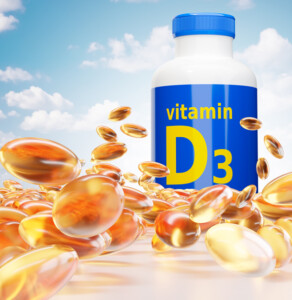




Cardiovascular disease (CVD) is a range of conditions characterized by their ability to affect heart health.1 The prevalence of CVD on a global scale is a significant cause of morbidity and mortality, and it accounts for nearly 18 million deaths yearly.2 Statin drugs, 3-hydroxy-3-methyglutaryl coenzyme A (HMG-CoA) reductase inhibitors, are the most commonly prescribed class of drugs for their proven track record in primary and secondary prevention of CVD. Statins work to reduce triglycerides, total cholesterol, and low-density lipoprotein (LDL) cholesterol levels and increase high-density lipoprotein (HDL) cholesterol levels.3 On the other hand, vitamin D supplementation is red hot, and while often ignored, the importance of food and drug interactions can sometimes be overlooked.4 The relationship between statins and vitamin D is interesting, and while the research remains a bit unclear and controversial, the benefits and risks must be explored.
Vitamin D
Vitamin D is a fat-soluble nutrient required for multiple physiological needs in the body. While it is a nutrient found in natural foods, fortified foods, beverages and supplements, it is, in actuality, a steroid hormone precursor. Cholecalciferol is generated from 7-dehydrocholesterol, a provitamin D sterol; that is transported to the liver, where it undergoes hydroxylation via the hepatic 25-hydroxylases by cytochrome (CYP) P450 enzymes: CYP2R1, CYP27A1 and CYP3A4.5 Calcidiol, or 25-hydroxycholecalciferol, is then shuttled to the local tissue level of the kidney and undergoes additional hydroxylation by way of 1α-hydroxylase by CYP27B1. From there, the physiologically active form of vitamin D is created: calcitriol or 1,25-dihydroxycholecalciferol, which works mostly through intracellular signaling pathways—influencing biotransformation pathways that may impact drug disposition and their overall performance, including statins.5,6
Statins
Statins, as mentioned previously, work in the body to reduce triglycerides, total and low-density lipoprotein (LDL) cholesterol levels, and increase high-density lipoproteins (HDL) by selectively inhibiting HMG-CoA reductase—reducing the risk of morbidity and mortality in CVD patients.3,7 However, not all statins are created equally, and some may interact with vitamin D in different capacities. Studies and expert analysis have suggested that statin use may reduce vitamin D serum levels, increasing the risk for statin-associated muscle symptoms and statin intolerance.8,9 Other studies suggest that impaired vitamin D status may be linked to cardiovascular risk factors and a higher risk for statin side effects, including myalgia, myositis and myopathy.10 And while it may be reasonable to assume that since vitamin D is synthesized from a cholesterol derivative and cholesterol reduction via statin-use, it could force a natural reduction of both cholesterol and vitamin D, some studies suggest otherwise.11 In fact, some rosuvastatin and atorvastatin usage studies have shown that circulating vitamin D levels can increase.11,12 And surprisingly, other studies have found that concurrent use of vitamin D supplements and statins reduce medication plasma concentration levels but collectively produce a stronger cholesterol-lowering effect.13
The Research
Since vitamin D and cholesterol share a common metabolic pathway with 7-dehydrocholesterol, it is not surprising that there is some interplay between these two. Previous investigations have sought to challenge and add to the literature data, documenting the unusual relationship between statins, vitamin D and cardiovascular health, while newer studies are inquiring about the relationship between statin intolerance, vitamin D levels and the rechallenge of statin therapy to offset side effects.
For example, vitamin D therapy in statin users may have implications on statin therapy. In one study, vitamin D therapy (800 IU [20 mcg]) was provided to postmenopausal women daily for two years as an intervention to prevent bone loss.14,15 After two years, the dosage in the treatment group was increased to 2,000 IU (50 mcg) daily for an additional year. A subset of this study population were statin users, and researchers pointed out that at baseline, statin-treated participants had significantly higher serum vitamin D levels than non-users. At final follow-up, the statin user subgroup had higher serum vitamin D levels, whether they were treated with vitamin D or not compared to non-statin users. These findings are a bit surprising considering that statin drugs work in the body by inhibiting the enzyme responsible for cholesterol’s natural synthesis. Since vitamin D is derived from cholesterol, it is reasonable to assume that reducing cholesterol via the rate-limiting enzyme would naturally reduce vitamin D levels within the body.
Alternatively, since vitamin D is an inducer of CYP3A4 that statin drugs metabolized by this enzyme would be rendered less effective. This latter notion has been tested in a single-blind, crossover, randomized clinical trial. Over six weeks, researchers analyzed hypercholesterolemia patients on stable atorvastatin therapy and vitamin D therapy (800 IU/daily) from a multivitamin and calcium product.13 It was hypothesized that adjunctive therapy would render the statin drug less effective or ineffective and subsequently raise cholesterol levels.17 While statin plasma concentrations were reduced, the adjunctive synergic treatment of vitamin D in statin users was significantly more effective in reducing cholesterol levels.13
Some clinical trials have focused on vitamin D and statin interplay, reporting that vitamin D3 in all its metabolite forms, except 1,25-dihydroxy vitamin D3, inhibits HMG-CoA reductase activity, reducing hepatic cholesterol biosynthesis and circulating cholesterol levels.7,16 Since this is the same mechanism of action as statin drugs, it would be of genuine interest to test the synergy of these two therapies, especially in those with depressed vitamin D status.
Hypercholesterolemia patients on stable statin therapies were recruited, and over six months were treated with vitamin D supplements (2,000 IU/daily) or placebo. The analysis results indicated that the dual therapy of vitamin D and statins, after six months, significantly reduced total serum cholesterol and triglyceride levels. Furthermore, this reduction was more pronounced in patients at baseline who exhibited vitamin D insufficiency (25-hydroxyvitamin D level <30 ng/mL).17
On another note, statins are associated with side effects, particularly muscle pain and myopathy. It has been suggested that these side-effects are amplified in patients with low vitamin D status. Researchers have assessed whether vitamin D therapy at dosage levels of 50,000-100,000 IU (1,250-2,500 mcg), one time weekly, would normalize serum vitamin D levels in statin-intolerant patients, possibly allowing for reinstation of statin therapy after treatment.18 The results indicated that vitamin D treated participants when statin therapy was reinstituted had significant LDL cholesterol and triglyceride reductions, and HDL cholesterol level increased at all time points (p < .0001).18 More importantly, at each follow-up period, previous statin-intolerant patients were declared free of myalgia, myositis, myopathy and myonecrosis; 88 percent, 91 percent, and 95 percent at six months, 12 months and 24 months, respectively.18
Conclusion
The present mini-summary highlights just a few studies that have directly focused on the concurrent therapy of statins and vitamin D, their interplay and the subsequent impact on cholesterol levels. Based on the evidence, there is a need for more extensive, longer clinical trials with a more tailored protocol for statin and vitamin D therapy. That said, despite its name, vitamin D is a prohormone, and its effects on cardiovascular health and statin use are accumulating; further research is warranted. VR
References
1 About heart disease. Centers for Disease Control and Prevention website. www.cdc.gov/heartdisease/about.htm (Links to an external site). Updated July 30, 2019. Accessed November 19, 2019.
2 Roth GA, Johnson C, Abajobir A, et al. Global, regional, and national burden of cardiovascular diseases for 10 causes, 1990 to 2015. J Am Coll Cardiol. 2017;70:1-25.
3 Statins. Drugs.com website. www.drugs.com/drug-class/hmg-coa-reductase-inhibitors.html (Links to an external site). Published August 30, 2018. Accessed November 19, 2019.
4 Rooney MR, Harnack L, Michos ED, Ogilvie RP, Sempos CT, Lutsey PL. Trends in use of high-dose vitamin D supplements exceeding 1000 or 4000 international units daily, 1999-2014. JAMA. 2017;317(23):2448–2450. doi:https://doi.org/10.1001/jama.2017.4392.
5 Wang Z, Schuetz EG, Xu Y, Thummel KE. Interplay between vitamin D and the drug metabolizing enzyme CYP3A4. J Steroid Biochem Mol Biol. 2013;136:54–58. doi:10.1016/j.jsbmb.2012.09.012.
6 Robien K, Oppeneer SJ, Kelly JA, Hamilton-Reeves JM. Drug-vitamin D interactions: A systematic review of the literature. Nutr Clin Pract. 2013;28(2):194–208. doi:10.1177/0884533612467824.
7 Gupta A, Thompson PD. The relationship of vitamin D deficiency to statin myopathy. Atherosclerosis. 2011;215(1):23-29.
8 Statin intolerance: Not a myth. American College of Cardiology website. www.acc.org/latest-in-cardiology/articles/2015/08/11/09/16/statin-intolerance-not-a-myth (linked to an external site). Published August 12, 2015. Accessed November 24, 2019.
9 Pennisi M, Bartolo GD, Malaguarnera G, Bella R, Lanza G, Malaguarnera M, Vitamin D serum levels in patients with statin-induced musculoskeletal pain. Dis Markers. 2019;2019:3549402: 1-6., https://doi.org/10.1155/2019/3549402.
10 Kumar J, Muntner P, Kaskel FJ, Hailpern SM, Melamed ML. Prevalence and associations of 25-hydroxyvitamin D deficiency in US children: NHANES 2001-2004. Pediatrics. 2009;124(3):e362–e370. doi:10.1542/peds.2009-0051
11 Ertugrul DT, Yavuz B, Cil H, et al. STATIN-D study comparison of the influences of rosuvastatin and fluvastatin treatment on the levels of 25 hydroxyvitamin D. Cardiovasc Ther. 2011;29:146–52.
12 Yavuz B, Ertugrul DT, Cil H, Ata N, Akin KO, Yalcin AA, et al. Increased levels of 25 hydroxyvitamin D and 1,25-dihydroxyvitamin D after rosuvastatin treatment: A novel pleiotropic effect of statins? Cardiovasc Drugs Ther. 2009;23:295–9.
13 Schwartz JB. Effects of vitamin D supplementation in atorvastatin-treated patients: New drug interaction with an unexpected consequence. Clin Pharmacol Ther. 2009;85(2):198–203.
14 Aloia JF, Talwar SA, et al. A randomized controlled trial of vitamin D3 supplementation in African American women. Arch Intern Med. 2005;165:1618–1623. [PubMed: 16043680]
15 Aloia JF, Li-Ng M, Pollack S. Statins and vitamin D. Am J Cardiol. 2007; 100(8): 1329.
16 Gupta A, Sexton R, Rudney H. Effect of vitamin D3 derivatives on cholesterol synthesis and HMG-CoA reductase activity in cultured cells. J Lipid Res. 1989;30:379–386.
17 Qin X, Zhao L, Chen W, Yin D, Wang H. Effects of vitamin D on plasma lipid levels in statin-treated patients with hypercholesterolemia: A randomized placebo-controlled trial. Clin Nutr. 2015;34(2):201-206.
18 Khayznikov M, Hemachrandra K, Pandit R, Kumar A, Wang P, Glueck CJ. Statin intolerance because of myalgia, myositis, myopathy, or myonecrosis can in most cases be safely resolved by vitamin D supplementation. N Am J Med Sci. 2015;7(3):86–93. doi:10.4103/1947-2714.153919.
Trisha Sugarek MacDonald holds a Master of Science in nutrition and is also working toward a doctorate in nutrition from Texas Woman’s University. MacDonald has nearly a decade and a half of experience in nutraceutical manufacturing and is currently the senior director of research & development as well as the national educator at Bluebonnet Nutrition, Sugar Land, TX, where she investigates new ingredients, directs the launch of new products, and provides industry training on numerous subjects as they relate to the connection between nutrition and health. She is a frequent editorial contributor and lecturer on the benefits surrounding the responsible use of supplements. For more information, call (800) 580-8866.