

Did anyone else read the Harry Potter books or watch the movies? One of the most terrifying things I encountered were the Dementors—dark, ghostly, floating monsters who froze the air and sucked the life out of their immobilized victims. Shiver! I learned later that J.K. Rowling herself had struggled with severe depression, and these monsters were informed by her experience of this mental health condition.
We are not designed to be happy all the time, and yet the media molds our thinking that something is wrong if life is not always sunshine and roses. When we do have a down day, when nothing feels right, when we can’t muster much energy and hope, when we are trying to slog our way through a bad stretch, we can feel like we are being cheated. We deserve happiness all the time, right? A healthier attitude would be to accept that life is full of peaks and valleys and sadness is to be expected. Cherish the good times, because they do not last. Have hope in the bad times, because they do not last, either.
Being sad because of a loss (your mother passed away) or an event (you lost your job) or an injury (you broke your leg) or something else entirely (dreary weather) is perfectly normal. Sadness is predictable and improves over time. Of course, it really helps to have the love and support of our friends and families during tough times.
However, sadness is not depression. Depression is a life-threatening illness involving brain inflammation, oxidative stress, neurotransmitter imbalance and interference with brain cell generation. Depression is not predictable, and while it may improve over time, sometimes it takes a very very long time (years). Depression is brain dysfunction that alters energy and perception, and the subsequent emotional reaction to those false perceptions can be dangerous.
An example: Bob feels worthless and hopeless and unloved. He perceives there is no meaning in life, and his emotions just keep sinking lower. Is this an accurate perception? Absolutely not! Of course, he is not worthless. Perhaps he is an accomplished business manager and makes an excellent salary, helping to support his family and making regular donations to charity. Maybe he is loved very much. And there are a multitude of reasons to feel hopeful, but Bob can neither see nor feel them. His brain has become disconnected from reality.
Telling someone with depression to go to a funny movie or just cheer up is not a very useful strategy. We need to repair the dysfunction and try to get the brain back on track.
Depression Background
According to the Centers for Disease Control (CDC), 13.8 percent of adults used an antidepressant medication within the past month during 2017-2018, which was an increase from 10.6 percent in 2009-2010. The largest group of people prescribed antidepressants (24.3 percent) were women over 60 years old.
The data we have thus far regarding the pandemic is looking even worse. In a study looking at mental health in children and adolescents, female participants experienced almost a tripling of their rate of clinically elevated depression as compared to pre-pandemic. And in a survey of more than 1,400 adults mild, moderate, moderately severe and severe depression all increased during the pandemic. The prevalence of depression overall increased more than three-fold versus pre-pandemic evaluation (8.5 percent to 27.8 percent). Depressive symptoms were found to be even worse when people were exposed to additional COVID-related stress (job loss, death of close friend or family member, etc.).
Prior to COVID-10, approximately 24 percent of people in the United States experienced symptoms of depression, mild or greater. During this pandemic, mild depression increased from 16.2 percent to 24.6 percent. Moderate depression increased from 5.7 percent to almost 15 percent. Moderately severe depression increased from 2.1 percent to 7.9 percent. And severe depression increased more than sevenfold from 0.7 percent to 5.1 percent! Those are some really challenging numbers!
Curcumin
One of the very best natural medicines for depression is curcumin, which has been proven in multiple clinical trials to have a significant antidepressant effect. It works by alleviating brain inflammation, arresting oxidative stress, stimulating brain cell generation (neurogenesis) and helping to restore better neurotransmitter valance.
In a randomized controlled trial, curcumin enhanced with turmeric essential oil (BCM-95), fluoxetine and a combination of curcumin and fluoxetine were investigated for their antidepressant effects. Sixty patients were evaluated using the Hamilton Depression Rating Scale with 17 items (HAM-D17). The combination group experienced the most positive response (77.8 percent of participants), whereas the curcumin and fluoxetine monotherapies had a 62.5 percent and 64.7 percent positive response, respectively. Overall, the mean change in HAM-D17 score over six weeks was similar between all three groups. Therefore, we know that enhanced absorption curcumin is as effective as prescription antidepressants and may be safe to use with prescription medication. However, we always encourage people to discuss combining pharmaceuticals with natural supplements for further guidance.
In a randomized, double-blind, placebo-controlled trial, 56 people with major depressive disorder were given 500 mg of curcumin enhanced with turmeric essential oil twice a day or placebo for eight weeks. Researchers evaluated curcumin’s effects on the Inventory of Depressive Symptomatology Self-Rate Version (IDS-SR30) and Spielberger State-Trait Anxiety Inventory (STAI). From week four to study end, curcumin significantly improved depressive symptoms and had a positive trend for STAI scores. The greatest effect was seen in those with atypical depression, which is excellent, because people with atypical depression are often the least likely to respond to prescription antidepressants. This study shows us that it probably takes about four or five weeks to see a lifting of some depression symptoms, so patience is needed.
Saffron
Saffron is another powerful antidepressant herbal. The good news is that it works differently from curcumin, and so is effective on its own, but is also an excellent partner in a formula. There is synergism between curcumin and saffron.
A 2016 study evaluated the treatment effect of low-dose curcumin (250 mg, twice per day), high-dose curcumin (500 mg, twice per day), curcumin (250 mg twice per day) combined with saffron (15 mg twice per day), or placebo. The curcumin and saffron group had by far the most significant improvements in Spielberger State-Trait Anxiety Inventory (STAI) scores. All three arms of the herbal groups outperformed placebo. People with atypical depression had the highest response rate.
Saffron works a little more quickly than curcumin, and benefits are often noticed after only two weeks. Its main activity is on rebalancing neurotransmitters. It also has an excellent side benefit: stress eating is reduced! Many people (including myself!) have used food to try to feel better. We have all had our pint of ice cream or bag of cookies moment. We crave fat and sweet because it triggers a tiny little release of dopamine, a brain chemical that causes a sense of pleasure. When we are desperate to feel better, we crave that little dopamine hit. In a human study, it was found that saffron reduces between meal snacking and stress eating by about 50 percent.
St. John’s Wort
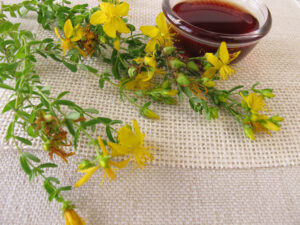
St. John’s wort is a tried-and-true herb with excellent benefits. Used in Germany for decades, its introduction to the United States created a tidal wave of demand for this plant. Many studies demonstrate its effectiveness for alleviating depression.
One example of the many studies on this herb involved 135 patients with major depressive disorder. Participants received standardized St. John’s wort, fluoxetine (a generic of the drug Prozac), or placebo for twelve weeks. St. John’s wort performed the best—by far—38 percent of the St. John’s wort group had a resolution of their depression, compared to 30 percent of the fluoxetine and 21 percent of the placebo groups.
St. John’s wort became less popular when it found it was also a really good detox agent—so good that it interacted with a lot of prescription drugs, moving them out of the body too fast. Therefore, if you use this herb, make sure you discuss with your doctor or pharmacist to see if any of your medications are on the list for contraindication with St. John’s wort use. If you are not on prescription medications, no worries!
There are newer one a day dosages of St. John’s wort available that greatly improve compliance for people who do not like to have to take three doses a day, but both are effective.
Vitamin D
Having written about vitamin D in many many articles, on everything from Alzheimer’s to cancer to COVID to heart disease, I have to ask myself, what can’t vitamin D do?
Therefore, it is no surprise that it plays a significant role in depression. If you live in the northern latitudes where sun to skin exposure is greatly reduced in the winter months, you may want to supplement with vitamin D every day whether struggling with depression or not.
In a human clinical trial, vitamin D was shown to have antidepressant effects within eight weeks in people over 60 years of age. Participants with moderate to severe depression were given 50,000 IU of vitamin D3 weekly or placebo. This would be the equivalent of about 7,000 IU per day. The researchers explored the change in Geriatric Depression Scale-15 (GDS-15) and change in vitamin D3 levels. Vitamin D levels increased from an average of 22.6 ng/mL to 43.5 ng/mL, while the depression score significantly decreased by almost 20 percent.
Depression SAM-e
Another popular supplement useful in alleviating depression is called s-andenosyl methionine, much easier to call it SAMe. This compound is made in the body and plays many roles in health, but one of its most investigated roles in supplemental use has to do with depression.
In a human study involving people that were unresponsive to selective serotonin reuptake inhibitors (SSRI), as defined as 20 mg per day or more of fluoxetine (generic for Prozac), citalopram (generic of Celexa) or paroxetine (generic of Paxil); 10 mg per day or more of escitalopram (generic of Lexapro); 50 mg per day or more of sertraline (generic of Zoloft); 60 mg per day or more of duloxetine (generic of Cymbalta); and 150 mg per day or more of venlafaxine (generic of Effexor), patients were given adjunctive treatment with 400 mg twice per day of SAMe or placebo. They doubled the SAMe dose after two weeks, while the drug dose remained the same throughout the six-week study. Over 50 percent of the SAMe participants responded well to the treatment and 25.6 percent achieved remission, versus 20.5 percent response and 5.8 percent remission in the placebo group.
This exhaustive study of most major antidepressant medications gives us an indication that even better results can be achieved with the addition of SAMe. The Future
It is important to think about depression as a potentially lethal disease and not a character flaw or minor mood challenge. We know many of the physical contributing factors, but much more research is needed to learn more about how we can help people live healthier, happier lives. If you are struggling with depression, please reach out for help. So much can be done to improve the situation. Please remember that your brain does not always tell you the truth. Depression is a disease in which one of the symptoms is a disconnect of perception from reality. One type of therapy, called Cognitive Behavioral Therapy (CBT) has been proved to be useful for many people with depression.
If you are feeling so low that you are starting to consider self-harm, please call the National Suicide Prevention Lifeline at (800) 273-8255. They are open 24 hours a day, seven days a week and speak both English and Spanish. They also have a website contact for the deaf and hard of hearing at https://suicidepreventionlifeline.org that supports TTY users.
Working together with natural health, lifestyle improvements, education to reduce the stigma of mental illness, and ongoing research to find even more effective treatments for this disease, the future is looking up! VR
References:
1 Al-Harbi KS. Treatment-Resistant Depression: Therapeutic Trends, Challenges, and Future Directions. Patient Prefer Adherence. 2012;6:369-388.
2 Alavi NM, et al. Effect of Vitamin D Supplementation on Depression in Elderly Patients: A Randomized Clinical Trial. Clin Nutr. 2019 Oct;38(5):2065-2070.
3 Brody DJ, Gu Q. Antidepressant use among adults: United States, 2015–2018. NCHS Data Brief, no 377. Hyattsville, MD: National Center for Health Statistics. 2020.
4 Ettman CK, et al. Prevalence of Depression Symptoms in US Adults Before and During the COVID-19 Pandemic. JAMA Nets Open. 2020;3(9):e2019686.
5 Fava M, et al. A Double-Blind, Randomized Trial of St John’s wort, Fluoxetine, and Placebo in Major Depressive Disorder. J Clin Pyschopharmacol. 2005 Oct;25(5):441-447.
6 Hawes MT, et al. Increases in Depression and Anxiety Symptoms in Adolescents and Young Adults During the COVID-19 Pandemic. Psychol Med. 2021 Jan 13;1-9.
7 Lopresti AL, et al. Curcumin for the Treatment of Major Depression: A Randomised, Double-Blind, Placebo Controlled Study. J Affect Disord. 2014;167:368-375.
8 Lopresti AL and Drummond PD. Efficacy of Curcumin, and a Saffron/Curcumin Combination for the Treatment of Major Depression: A Randomised, Double-Blind, Placebo-Controlled Study. J Affect Disord. 2017 Jan 1;207:188-196.
9 Papakostas GI, et al. S-Adenosyl Methionine (SAMe) Augmentation of Serotonin Reuptake Inhibitors for Antidepressant Nonresponders with Major Depressive Disorder: A Double-Blind, Randomized Clinical Trial. Am J Psychiatry. 2010 Aug;167(8):942-948.
10 Sanmukhani J, et al. Efficacy and Safety of Curcumin in Major Depressive Disorder: A Randomized Controlled Trial. Phytother Res. 2014 Apr;28(4):579-585.
11 Mazidi M, Shemshian M, Mousavi SH, et al. A double-blind, randomized and placebo-controlled trial of Saffron (Crocus sativus L.) in the treatment of anxiety and depression. J Complement Integr Med. 2016 Jun 1;13(2):195-9. doi: 10.1515/jcim-2015-0043.
12 Georgiadou G, Tarantilis PA, Pitsikas N. Effects of the active constituents of Crocus Sativus L., crocins, in an animal model of obsessive-compulsive disorder. Neurosci Lett. 2012 Oct 18;528(1):27-30. doi: 10.1016/j.neulet.2012.08.081. Epub 2012 Sep 7.
13 Hosseinzadeh H, Sadeghnia HR. Protective effect of safranal on pentylenetetrazol-induced seizures in the rat: involvement of GABAergic and opioids systems. Phytomedicine. 2007 Apr;14(4):256-62. Epub 2006 May 16.
14 O’Connor TM, O’Halloran DJ, Shanahan F. The stress response and the hypothalamic-pituitary-adrenal axis: from molecule to melancholia. QJM. 2000;93(6):323-33. 15 Tabeshpour J, Sobhani F, Sadjadi SA, et al. A double-blind, randomized, placebo-controlled trial of saffron stigma (Crocus sativus L.) in mothers suffering from mild-to-moderate postpartum depression. Phytomedicine. 2017 Dec 1;36:145-152. doi: 10.1016/j.phymed.2017.10.005. Epub 2017 Oct 7.
16 Sanmukhani J, Satodia V, Trivedi J, Patel T, Tiwari D, Panchal B, Goel A, Tripathi CB. Efficacy and Safety of Curcumin in Major Depressive Disorder: A Randomized Controlled Trial. Phytother Res. 2013 Jul 6. doi: 10.1002/ptr.5025.
17 Lopresti AL, Maes M, Maker GL, Hood SD, Drummond PD. Curcumin for the treatment of major depression: a randomised, double-blind, placebo controlled study. J Affect Disord. 2014;167:368-75.
18 Lopresti AL, Drummond PD. Efficacy of curcumin, and a saffron/curcumin combination for the treatment of major depression: A randomised, double-blind, placebo-controlled study. Journal of Affective Disorders. 2017;207:188-196.
19 Akhondzadeh S, Tahmacebi-Pour N, Noorbala AA, et al. Crocus sativus L. in the treatment of mild to moderate depression: a double-blind, randomized and placebo-controlled trial. Phytother Res. 2005 Feb;19(2):148-51.
20 Lawvere S, Mahoney MC. St. John’s wort. Am Fam Physician. 2005;72(11):2249-54.
21 Linde K. St. John’s wort – an overview. Forsch Komplementmed. 2009 Jun;16(3):146-55.
22 St. John’s Wort. In: PDR for Herbal Medicines, 4th ed. Montvale, NJ: Physician’s Desk Reference; 2007:797-811.
23 Singer A, Schmidt M, Hauke W, Stade K. Duration of response after treatment of mild to moderate depression with Hypericum extract STW 3-VI, citalopram and placebo: A reanalysis of data from a controlled clinical trial. Phytomedicine. 2011 Apr 20.
24 Monograph. Hypericum perforatum. Altern Med Rev. 2004 Sep;9(3):318-25.
25 Brockmöller J, Reum T, Bauer S, Kerb R, Hübner WD, Roots I. Hypericin and pseudohypericin: pharmacokinetics and effects on photosensitivity in humans. Pharmacopsychiatry. 1997;30 Suppl 2:94-101.
26 Goel A, Kunnumakkara AB, Aggarwal BB. Curcumin as “Curecumin”: from kitchen to clinic. Biochem Pharmacol. 2008 Feb 15;75(4):787-809.
27 Hatcher H, Planalp R, Cho J, et al. Curcumin: from ancient medicine to current clinical trials. Cell Mol Life Sci 2008;65:1631-1652.).
28 Kulkarni S, Dhir A, Akula KK. Potentials of curcumin as an antidepressant. Scientific World Journal. 2009;9:1233-41.
29 Xu Y, Ku BS, Yao HY, Lin YH, Ma X, Zhang YH, Li XJ. Antidepressant effects of curcumin in the forced swim test and olfactory bulbectomy models of depression in rats. Pharmacol Biochem Behav. 2005;82(1):200-6.
30 Li YC, Wang FM, Pan Y, Qiang LQ, Cheng G, Zhang WY, Kong LD. Antidepressant-like effects of curcumin on serotonergic receptor-coupled AC-cAMP pathway in chronic unpredictable mild stress of rats. Prog Neuropsychopharmacol Biol Psychiatry. 2009;33(3):435-49.
31 Sanmukhani J, Anovadiya A, Tripathi CB. Evaluation of antidepressant like activity of curcumin and its combination with fluoxetine and imipramine: an acute and chronic study. Acta Pol Pharm. 2011 Sep-Oct;68(5):769-75.
32 Antony B, Merina B, Iyer VS, Judy N, Lennertz K, Joyal S. A pilot cross-over study to evaluate human oral bioavailability of BCM-95 CG (Biocurcumax™) a novel bioenhanced preparation of curcumin. Ind J Pharm Sci. 2008:445-449.
33 Benny B, Antony B. Bioavailability of Biocurcumax (BCM-95). Spice India. September, 2006:11-15.
34 Suicide Prevention Lifeline. Available at : https://suicidepreventionlifeline.org/. Accessed January 7, 2022.
Cheryl Myers is an integrative health nurse, author, and an expert on natural medicine. She is a nationally recognized speaker who has been interviewed by the New York Times, Wall Street Journal and Prevention magazine. Her many articles have been published in such diverse journals as Aesthetic Surgery Journal and Nutrition in Complementary Care, and her research on botanicals has been presented at the American College of Obstetrics and Gynecology and the North American Menopause Society. Myers is the head of scientific affairs and education for EuroPharma, Inc.