


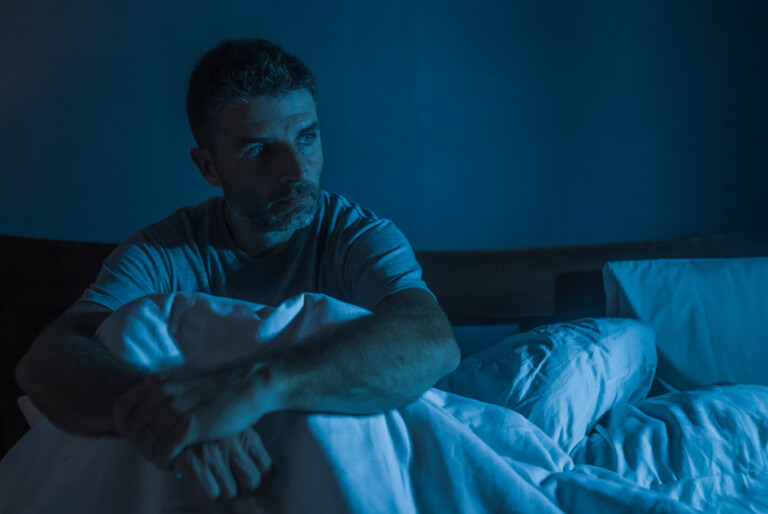
Struggling with insomnia is tough enough. When it’s caused by stress & anxiety, things just got twice as bad!
At least 10 percent of us—and probably a lot more—struggle with insomnia. Insomnia is not only frustrating and exhausting, but it can also destroy your quality of life. It can contribute to illness, pain, obesity, insulin insensitivity and high blood pressure.
Drugs for insomnia aren’t the answer because they bring their own problems, including morning hangover, addiction, memory problems, confusion, depression and nervousness. They also inhibit real sleep by suppressing REM sleep. Research has even found an increased risk of Alzheimer’s disease for older people who use benzodiazepines.1,2 Compounding the problem for many is that insomnia is often related to stress or anxiety, doubling the burden. But many natural remedies can take care of the insomnia and the stress or anxiety that causes it.
Valerian
Valerian is the king of sleep herbs. Less known is that it is also as good as drugs for anxiety. When researchers compared valerian to oxazepam for insomnia, they found an unexpected result: it not only equalled the drug for insomnia, but it also equalled it for anxiety and with fewer side effects.3
Kava Kava
Whereas valerian is the king of sleep herbs that also works on anxiety, kava is the king of anxiety herbs that also works on insomnia. Kava improves sleep quality without interfering with REM sleep. Kava is the undisputed champion for anxiety. A head-to-head study found that kava, providing 210 mg of kavalactones, is as effective as the benzodiazepines bromazepam and oxazepam while having the advantage of being safer.4 A second double-blind study also found that anxiety improved on all three treatments.5 And a third study comparing 400 mg of kava standardized for 30 percent kava lactones to anxiety medications in an eight-week double-blind study again showed kava to be as effective as drugs.6
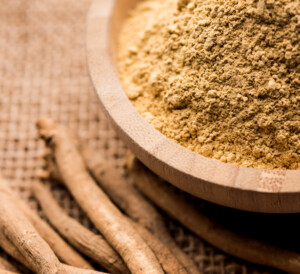
Ashwagandha
Ashwagandha is an herb that seems to specialize in anxiety, stress and sleepless nights.
All kinds of research shows that ashwagandha eases anxiety, including a systematic review of five controlled studies.7 Research shows that it eases stress, too,8 as well as helping if you’re struggling with both.9
Research has recently been piling up that ashwagandha is a remarkable herb for insomniacs with anxiety. A 10-week double-blind study of people struggling with anxiety and insomnia gave them 300 mg of ashwagandha root extract twice a day or a placebo. The people on ashwagandha fell asleep significantly faster. They also woke up significantly less often during the night. Quality of sleep improved significantly more on ashwagandha: an improvement of 3.92 points versus 1.67 on placebo. Overall, sleep scores improved by 69 percent on ashwagandha versus 11 percent on placebo. As for anxiety, scores on the Hamilton Anxiety Rating Scale improved significantly in the ashwagandha group. The placebo group improved from a score of 23.42 to 21.52; the ashwagandha improved from 23.58 to 18.48.10
A second study showed that ashwagandha produces significantly greater improvement than placebo on the Pittsburgh Sleep Quality Index. People fall asleep significantly faster and have significantly better quality of sleep. They have significantly greater total sleep time and wake up significantly less often once they have fallen asleep. And again, those who took ashwagandha to help with insomnia also received help for anxiety: scores on the Hamilton Anxiety Scale improved significantly.11
Saffron
Saffron powerfully fights insomnia, anxiety and stress. At least half a dozen studies have proven saffron to lull insomniacs to sleep. It also improves anxiety12 and stress.13 When it comes to anxiety, a meta-analysis of six studies demonstrated superiority to placebo14 and double-blind research has proven it to be a match for the drug citalopram.15
When it comes to people suffering from insomnia and anxiety, a double-blind study found that saffron helps people with mild to moderate insomnia and anxiety to fall asleep easier and stay asleep longer.16 In people whose insomnia is associated with anxiety, saffron helps people to fall asleep faster and to sleep better and longer.17
Passionflower
Passionflower is a gentle, effective sleep herb that is great for stubborn, chronic insomnia. It is also great for anxiety, so it is another herb that is perfect for insomnia caused by anxiety. Passionflower has gone head-to-head with the benzodiazepine oxazepam in double-blind research and won because it works just as well, but oxazepam impaired daily functioning significantly more than passionflower.18
Lavender
Inhaling lavender essential oil helps you sleep as well as sleeping medications.19,20 Women who have recently given birth and who have a sleeping disorder sleep better when they place four drops of 10 percent lavender essential oil on a cotton ball beside their pillow.21
Lavender is as good as drugs for anxiety. Lavender oil capsules are as good as the benzodiazepine lorazepam in people with generalized anxiety disorder (GAD). Unlike benzodiazepines, though, lavender oil is safe, non-sedating and non-addictive.22 Lavender oil is also more effective and safer than the SSRI paroxetine for GAD.23
What about insomnia and anxiety? Double-blind research shows that giving an 80 mg capsule of lavender essential oil to people suffering from restlessness, anxiety, tension and insomnia improves anxiety.24
Chamomile
Chamomile is a well-known calming herb that is traditionally used for insomnia. But it is also great for anxiety. Double-blind research shows that chamomile extract is significantly better than placebo for people with GAD.25 An unblinded study found that 1,500 mg of chamomile extract a day for eight weeks significantly improves symptoms in people with moderate to severe GAD. Also, 58.1 percent had a clinical response. The researchers concluded that chamomile’s results were comparable to anti-anxiety drugs while being safer.26
Lemon Balm & Lemon Verbena
Lemon balm is a gentle herb that is called for whenever the word “nervous” appears, including nervous tension. The German Commission E approves lemon balm for “nervous sleeping disorders.”
Another traditional relaxing herb, lemon verbena has recently been shown to help stressed out insomniacs. When they were given 400 mg a day of lemon verbena, standardized to 28 percent phenylpropanoids, or a placebo, the lemon verbena group had significantly reduced stress and improved sleep. For some reason, it worked especially well for women.27
Black Seed
Not normally thought of for sleep, this double-blind study surprised by finding that 200 mg a day of black seed oil significantly improves sleep duration, quality and time to fall asleep compared to placebo. It also improved stress significantly better than placebo. Black seed seemed to increase melatonin and decrease the stress hormone cortisol.28VR
Sources:
1 BMJ 2012;345:e6231.
2 BMJ 2014;349:g5205.
3 Forsch Komplementarmed Klass Naturheilkd 2000;7:79-84.
4 Z Allg Med 1993;69:271-7.
5 MMW Fortschr Med 2002;144:47.
6 Phytomed 2003;10:38-49.
7 J Altern Complement Med 2014;20:901- 908.
8 Indian J Psychol Med 2012;34:255-62.
9 JANA 2008;11:50-56.
10 Cureus 2019; 11(9): e5797.
11 J Ethnopharmacol 2021;264,113276.
12 J Complement Integr Med. 2016 Jun 1;13(2):195-9.
13 Complement. Ther. Med. 2017, 33, 58–64.
14 Nutr Rev 2019 May 28:nuz023.
15 Pharmacopsychiatry. 2017 Jul;50(4):152-160.
16 Nutrients. 2021 May; 13(5): 1473.
17 Nutrients 2021, 13(5), 1473.
18 J Clin Pharm Ther 2001;26:363- 7.
19 Lancet 1995;346:701.
20 J Altern Complement Med 2005;11:631–7.
21 Iran Red Crescent Med J 2015;e25880.
22 Phytomed 2010;17(2):94-9.
23 Int J Neuropsychopharmacol 2014;17(6):859-869.
24 Eur Neuropsychopharmacol 2015;25(11):1960-7.
25 J Clin Phsycopharmacol 2009;29: 378-382.
26 Phytomed 2016;23(14):1699-1705.
27 Nutrients 2022;14(1):218.
28 Front Nutr. April 2023;10:doi.org/10.3389/fnut.2023.1152680.
Linda Woolven is a master herbalist, acupuncturist and solution-focused counsellor with a virtual practice in Toronto, ON, Canada. Woolven and Ted Snider are the authors of several books on natural health. You can see their books at www.thenaturalpathnewsletter.com. They are also the authors of the natural health newsletter The Natural Path. The Natural Path is a natural health newsletter specifically designed to help health food stores increase their sales by educating their customers. The Natural Path contains no advertising and never mentions a brand name. Retailers can provide The Natural Path Newsletter to their customers. For more information, contact Snider at [email protected] or (416) 782-8211.
![[Extra! Extra!] Gnosis Discusses What Retailers Should Know About Stress Relief Products](https://vitaminretailer.com/wp-content/uploads/2026/03/Stress-Anxiety-300x285-1774638246.jpg)