


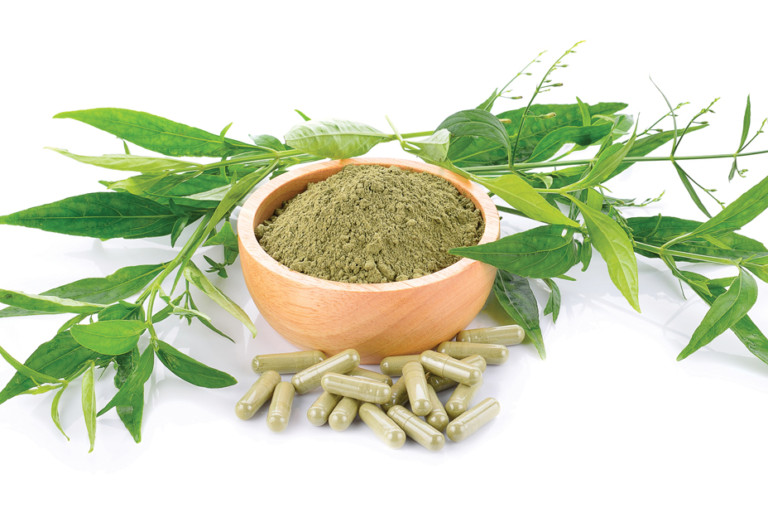
In the March 31, 2020 issue of the Journal of Lung, Pulmonary & Respiratory Research, an editorial appeared entitled, “Andrographis paniculata (Green chiretta) may combat COVID-19.”1 The editorial concluded by advising that in-vitro and in-vivo studies are needed before beginning clinical trials on killing effects of A. paniculata on COVID-19. In this article, we will examine the research on A. paniculata in the treatment of COVID-19. But first, let’s take a look at prior research on A. paniculata.
Background
A. paniculata is an herb with a history of use in both ayurvedic and traditional Chinese medicine. Called the “king of bitters” in Asia, Andrographis contains a number of bitter constituents (including andrographolide, dehydroandrographolide, neoandrographolide and deoxyandrographolide) which appear to have both immune-modulating and anti-inflammatory activity.2 In short, the effect of Andrographis paniculata and its andrographolides on inflammation is impressive, as is its effects the human clinical research on this herb on safely and effectively reducing joint inflammation (i.e. swollen joints) and joint tenderness in arthritis sufferers is even more impressive when and Andrographis extract is used providing 50 percent total andrographolides (ParActin, HP Ingredients). For more information on the anti-inflammatory effects of Andrographis, see the article I previously wrote for the January 2018 issue of Vitamin Retailer, entitled “Standardized Andrographis paniculata for Pain & Inflammation.”
In Scandinavia, Andrographis extract has been extensively used for treating upper respiratory tract infections and common colds. Further studies indicate that a decoction of Andrographis was able to inhibit the growth of S. aurea, Pseudomonas aeroginosa, Proteus vulgaris, Shigella dysenteriae and Escherichia coli. Therefore, Andrographis is indicated for different diseases ranging from bacterial dysentery, stomach and intestine disorders, tonsilitis, pneumonia, pyelonephritis to abscesses AP extract was tested in acute, subacute, reproductive, toxicological studies without encountering toxic effects.3
Likewise, Andrographolide and its derivatives in Andrographis have been reported to have potent anti-viral activity against diverse group of viruses belonging to different families including influenza A virus (H1N1), Hepatitis B virus (HBV), Hepatitis C virus (HCV), Herpes simplex virus 1 (HSV-1), Chikungunaya virus (CHV), Human immunodeficiency virus (HIV), Human papillomavirus (HPV) and Epstein-Barr virus (EBV).4
Now let’s take a look at research on the use of Andrographis in the treatment of the common cold virus.
Clinical Research on Common Cold
A three-month, randomized, placebo-controlled, double-blind study5 was conducted on 107 patients to evaluate the effectiveness of standardized Andrographis extract (as ParActin) in the prevention of common colds during the winter season. University students were divided in two groups, of which Group 1 (n=54) received Andrographis extract 25 mg per day and Group 2 (n=53) received a placebo. The individuals were evaluated weekly by a clinician who diagnosed the presence or absence of common colds during the three months. Results were that, after the second month of intake, there was a significant decrease in the incidence of colds in the Andrographis group as compared to the placebo group. The rate of incidence for colds among the students treated with Andrographis was 30 percent (16/54) compared to 62 percent (33/53) with placebo. The relative risk of catching a cold was therefore 2.1 times lower for the Andrographis group. The results suggest that Andrographis extract has a preventive effect against common colds during the winter period.
While the previous study demonstrated the effectiveness of standardized Andrographis extract (as ParActin) in the prevention of common colds, this randomized, double-blind, placebo-controlled study6 examined the effectiveness of Andrographis extract (as ParActin) in reducing the prevalence and intensity of symptoms and signs of an existing common cold as compared with a placebo. A group of 158 adult patients of both sexes were divided in two equal size groups, one of which received Andrographis extract (200 mg, three times daily) and the other a placebo during a five-day period. On day 0, 2 and 4 of the treatment patients completed a self-evaluation (VAS) sheet with the following parameters: headache, tiredness, earache, sleeplessness, sore throat, nasal secretion, phlegm, frequency and intensity of cough. At day 2 of treatment there was a significant decrease in the intensity of symptoms of tiredness, sleeplessness, sore throat and nasal secretion in the Andrographis group as compared with the placebo group. At day 4, a significant decrease in the intensity of all symptoms was observed for the Andrographis group. There were higher values were for the following parameters: sore throat, nasal secretion and earache for Andrographis treatment over placebo. In conclusion, Andrographis extract (as ParActin) had a high degree of effectiveness in reducing the prevalence and intensity of the symptoms in uncomplicated common cold beginning at day two of treatment. No adverse effects were observed or reported.
A randomized, placebo-controlled, double-blind study7 was conducted on 50 patients to evaluate the effect of Andrographis extract tablets, standardized for andrographolide and deoxyandrographolide content on symptoms connected with common cold, especially the patients subjective experience of the cold, the number of days on sick leave and the time for complete recovery and return to work. The patients were given 100 tablets of either placebo or Andrographis (providing 85 mg extract/tablet). The patients were advised to take four tablets, three times daily. After five days of treatment the patients returned to the clinic for diagnosis. Results were that, after the second visit, the sick leave days in the placebo group were 0.96 days, whereas in the Andrographis group the sick leave days were only 0.21 days (p<0.03), a significant difference. In the placebo group the number of patients that declared themselves as totally recovered were 36 percent, and in the Andrographis group the number of patients that declared themselves as totally recovered 67.5 percent (p <0.046). Also, the number or patients that experienced reduced symptoms compared to “normal” were 55 percent in the Andrographis group versus 19 percent in the placebo group (P<0.025). In conclusion, the findings of this study established that treatment with Andrographis tablets influence the subjective experience of the of common cold, as well as the number of days on sick leave.
Other placebo-controlled, double-blind studies8-11 also examined the therapeutic effect of Andrographis extract in patients with common colds, with similar beneficial results. Now let’s look at studies examining the effects of Andrographis extract and COVID-19.
COVID-19 Studies
Pharmacological and clinical studies indicate that Andrographis is of help in epidemics. Indeed, during the influenza epidemic of 1919 in India, a tincture of Andrographis was effective in arresting the epidemic’s spread.12 Consequently, there is a precedence for examining the effectiveness of Andrographis in the treatment of COVID-19—the studies for which are summarized below.
Research13 has demonstrated that both andrographolide (from Andrographis) suppressed the main protease (Mpro) activities of 2019-nCoV and severe acute respiratory syndrome coronavirus (SARS-CoV). This is significant since Mpro is a protein essential for the lifecycle of 2019-nCoV. Two other studies14-15 with andrographolide showed similar results.
In addition, an in-vitro study,16 post-infection treatment with Andrographis and andrographolide in SARS-CoV-2-infected human lung epithelial cells significantly inhibited the production of infectious virions (i.e. the complete, infective form of a virus outside a host cell) with an IC50 of 0.036 μg/mL and 0.034 μM, respectively, as determined by the plaque assay. In conclusion, this study provided experimental evidence in favor of Andrographis and andrographolide for further development as a monotherapy or in combination with other effective drugs against SARS-CoV-2 infection.
Furthermore, a computation approach was used to target host pathways to reduce the cytokine storm induced by SARS-CoV-2 infection. The study17 identified andrographolide from Andrographis as having the potential to bind with crucial proteins to block the TNF-induced NFkB1 signaling pathway responsible for cytokine storm in COVID-19 patients.
While these studies are promising, the real proof of the pudding is in human clinical research, which was shown with Xiyanping (XYP), a Chinese herbal medicine used in the clinic to treat respiratory infection and pneumonia. XYP is primarily composed of 9-dehydro-17-hydroandrographolide and sodium 9-dehydro-17-hydro-andrographolide-19-yl sulfate, which are derived from Andrographis. This prospective, multicenter, open-label and randomized controlled trial18 evaluate the safety and effectiveness of XYP injection in patients with mild to moderate COVID-19. One hundred and thirty COVID-19 patients with mild to moderate symptoms received XYP injection in combination with standard therapy or received standard supportive therapy alone. Results were that XYP injection significantly reduced the time to cough relief, fever resolution and virus clearance. Less patients receiving XYP injection experienced disease progression to the severe stage during the treatment process. No severe adverse events were reported during the study. Taken together, XYP injection was found to be safe and effective in improving the recovery of patients with mild to moderate COVID-19. Further studies are warranted.
Conclusion
Not only has Andrographis been shown to have anti-inflammatory and immune-modulating activity, but human clinical research has also demonstrated that it is effective in the prevention and treatment of the common cold—especially when used as ParActin (HP Ingredients). Of particular interest is that preclinical and clinical research suggest that Andrographis extract and it’s various andrographolide constituents may be a safe and effective way to help promote recovery in patients with mild to moderate COVID-19. VR
References
1 Cheepsattayakorn A, Cheepsattayakorn R. Andrographis paniculata (Green chiretta) may combat COVID-19. J Lung Pulm Respir Res. 2020;7(2):26. DOI: 10.15406/jlprr.2020.07.00224. 2 Bone K. Clinical Applications of Ayurvedic and Chinese Herbs: Monographs for the Western Herbal Practitioner. Queensland, Australia: Phytotherapy Press; 1996:96–100.
3 Hancke J, Buros R, Caceres D, Wikman G. A Double-blind Study with a New Monodrug Kan Jang: Decrease of Symptoms and Improvement in the Recovery from Common Colds. Phyto. Res. 1995; 9:559-562.
4 Murugan NA, Pandian CJ, Jeyakanthan J. Computational investigation on Andrographis paniculata phytochemicals to evaluate their potency against SARS-CoV-2 in comparison to known antiviral compounds in drug trials. J Biomol Struct Dyn. 2021 Aug;39(12):4415-4426. 5 Cáceres DD, Hancke JL, Burgos RA. Double Blind, Placebo Controlled Study: Prevention of common colds with PARACTIN. Unpublished; 2007: 3 pgs.
6 Cáceres DD, Hancke JL, Burgos RA. PARACTIN (14-Neo Andro) Reduce the Intensity of Symptoms and Signs of a Common Cold. Unpublished; 2007: 6 pgs.
7 Melchior J, Palm S, Wikman G. Controlled clinical study of standardized Andrographis paniculata extract in common cold—a pilot trial. Phytomedicine 1997;3(4):315–8.
8 Hancke J, Burgos R, Caceres D, Wikman G. A double-blind study with a new monodrug Kan Jang: Decrease of symptoms and improvement in recovery from common colds. Phytother Res 1995;9:559–62.
9 Cáceres DD, Hancke JL, Burgos RA, et al. Use of visual analogue scale measurements (VAS) to assess the effectiveness of standardized Andrographis paniculata extract SHA-10 in reducing the symptoms of common cold. A randomized double blind-placebo study. Phytomedicine 1999;6:217–23.
10 Cáceres DD, Hancke JL, Burgos RA, et al. Use of visual analogue scale measurements (VAS) to asses the effectiveness of standardized Andrographis paniculata extract SHA-10 in reducing the symptoms of common cold. A randomized double blind-placebo study. Phytomedicine. 1999 Oct;6(4):217-23.
11 Saxena RC, Singh R, Kumar P, et al. A randomized double blind placebo controlled clinical evaluation of extract of Andrographis paniculata (KalmCold) in patients with uncomplicated upper respiratory tract infection. Phytomedicine. 2010 Mar;17(3-4):178-85.
12 Murugan NA, Pandian CJ, Jeyakanthan J. Computational investigation on Andrographis paniculata phytochemicals to evaluate their potency against SARS-CoV-2 in comparison to known antiviral compounds in drug trials. J Biomol Struct Dyn. 2021 Aug;39(12):4415-4426.
13 Shi T-H, Huang Y-L, Chen C-C, et al. Andrographolide and its fluorescent derivative inhibit the main proteases of 2019-nCoV and SARS-CoV through covalent linkage. Biochem Biophys Res Commun. 2020 Dec 10;533(3):467-473.
14 Enmozhi SK, Raja K, Sebastine I, Joseph J. Andrographolide as a potential inhibitor of SARS-CoV-2 main protease: an in silico approach. J Biomol Struct Dyn. 2021 Jun;39(9):3092-3098.
15 Murugan NA, Pandian CJ, Jayakanthan J. Computational investigation on Andrographis paniculata phytochemicals to evaluate their potency against SARS-CoV-2 in comparison to known antiviral compounds in drug trials. J Biomol Struct Dyn. 2021 Aug;39(12):4415-4426.
16 Sa-Ngiamsuntorn K, Suksatu A, Pewkliang Y, et al. Anti-SARS-CoV-2 Activity of Andrographis paniculata Extract and Its Major Component Andrographolide in Human Lung Epithelial Cells and Cytotoxicity Evaluation in Major Organ Cell Representatives. J Nat Prod. 2021 Apr 23;84(4):1261-1270.
17 Rehan M, Ahmed F, Howdlaar SM, et al. A Computational Approach Identified Andrographolide as a Potential Drug for Suppressing COVID-19-Induced Cytokine Storm. Front Immunol. 2021 Jun 24;12:648250.
18 Zhang X-Y, Lv L, Zhou Y-L, et al. Efficacy and safety of Xiyanping injection in the treatment of COVID-19: A multicenter, prospective, open-label and randomized controlled trial. Phytotherapy Research. 2021;1–10. DOI: 10.1002/ptr.7141.
Gene Bruno, MS, MHS, the dean of academics for Huntington University of Health Sciences, is a nutritionist, herbalist, writer and educator. For more than 30 years he has educated and trained natural product retailers and health care professionals, has researched and formulated natural products for dozens of dietary supplement companies, and has written articles on nutrition, herbal medicine, nutraceuticals and integrative health issues for trade, consumer magazines and peer-reviewed publications. He can be reached at [email protected].

![[Extra! Extra!] Top 10 Immune-boosting Foods and Supplements](https://vitaminretailer.com/wp-content/uploads/2025/08/Immune-Health-300x286-1756141464.jpg)