


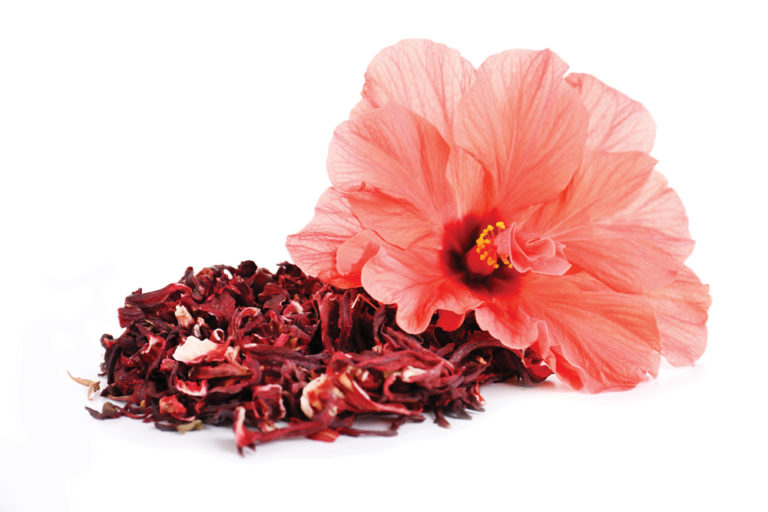
In addition to its popularity as a tropical flower found in landscapes, hibiscus (Hibiscus sabdariffa) also has a history of use as a medicinal herb. In Egypt it has been used to treat cardiac and nerve diseases and as a diuretic,1 and in North Africa it has been used to treat cough, sore throat and genital problems.2 Likewise, hibiscus tea (sometimes called sour tea) is used traditionally to treat hypertension.3 This last use has been closely examined in human clinical studies, and is one of the two topics of this article along with effects on blood lipid levels.
Mechanism(s) of Action
While its vibrant red flower buds, or calyces, are known to provide the active medicinal activity of hibiscus, the mechanism of action for this herb has not always been understood. In human and animal research, hibiscus was found to act as a diuretic and inhibit angiotensin-converting enzyme (ACE). Its ACE inhibition properties are meaningful since ACE indirectly increases blood pressure by causing blood vessels to constrict. Nevertheless, these mechanisms may be less important mechanisms than those related to the antioxidant, anti-inflammatory, and endothelium-dependent effects. Specifically, the polyphenols in hibiscus induced a favorable endothelial response that researchers stated “should be considered in the management of metabolic cardiovascular risks.”4 In any case, a review5 of scientific evidence indicated that hibiscus offers therapeutic effects on oxidative stress, lipid profile, hypertension and atherosclerosis.
Human Clinical Research on Hypertension
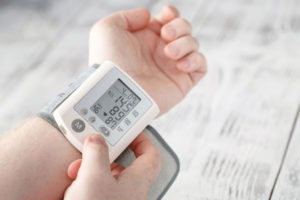
As a tea, clinical research shows that daily consumption of hibiscus was able to lower blood pressure in adults with pre-hypertension or mild hypertension. Doses used were typically 1.25-2 grams, brewed in 240 mL of water, and consumed two to three times daily—resulting in significantly reducing systolic and diastolic blood pressure compared to control teas after two to six weeks of treatment.6-8 As a standardized extract, clinical research shows that taking hibiscus before breakfast for four weeks is as effective as taking captopril 25 mg twice daily for reducing systolic and diastolic blood pressure in people with mild to moderate hypertension.9 Following are the details of those studies.
Studies on Hibiscus Tea and Hypertension
A randomized, double-blind, placebo-controlled clinical trial10 was conducted in 65 pre- and mildly hypertensive adults (age 30-70 years). Subjects received three 240-mL daily servings of brewed hibiscus tea or placebo beverage for six weeks. The results showed that there was a statistically significant (P=0.030) lowering of systolic blood pressure (SBP) in the hibiscus group (-7.2 mm Hg) compared with the placebo group (-1.3 mm Hg;). Diastolic BP was also lower in the hibiscus group (-3.1 mm Hg) compared to the placebo group (-0.5 mm Hg) although the difference did not reach statistical significance). In addition, subjects with higher SBP at baseline showed a greater response to hibiscus treatment (P = 0.010). The authors of the study concluded that daily consumption of hibiscus tea lowers BP in pre- and mildly hypertensive adults and may prove an effective component of the dietary changes recommended for people with these conditions.
In a randomized, controlled trial,11 54 patients were assigned to the hibiscus tea group or the control group (ordinary tea). Subjects consumed one serving of tea at least 1 h before measuring the blood pressure. The results showed an 11.2 percent lowering of the systolic blood pressure and a 10.7 percent decrease of diastolic pressure in the hibiscus group 12 days after beginning the treatment, as compared with the first day. The difference between the systolic and diastolic blood pressures of the two groups was significant. Three days after stopping the treatment, systolic blood pressure was elevated by 7.9 percent, and diastolic pressure was elevated by 5.6 percent in both groups. The authors concluded the study results “proves the public belief and the results of in vitro studies concerning the effects of sour tea on lowering high blood pressure.”
Similarly, a double-blind randomized controlled trial12 was conducted to compare the antihypertensive effectiveness of hibiscus tea with black tea in 60 type-2 diabetic patients with hypertension. Subjects drank their teas two times a day for one month, preparing them by placing 2 grams of the tea in a tea pot, adding 240 ml of boiling water and drinking it after a steeping time of 20–30 minutes with one cube of sugar. Results showed that the systolic BP in the hibiscus group decreased from 134.4 mm Hg at the beginning of the study to 112.7 mm Hg after one month (P-value <0.001), but the black tea group experienced an increase from 118.6 to 127.3 mm Hg. In conclusion, consuming hibuscus tea had positive effects on BP in type 2 diabetic patients with mild hypertension.
Studies on Hibiscus Extract and Hypertension
A four-week, randomized, controlled clinical trial13 was conducted to compare the antihypertensive effectiveness and tolerability of a standardized extract of hibiscus with captopril (an ACE inhibitor drug used to treat hypertension) in 75 hypertensive patients from 30 to 80 years old. The hibiscus extract provided 9.6 mg of anthocyanins, and was taken daily before breakfast. The captopril was taken 25 mg twice a day, for four weeks. The results showed that hibiscus was able to decrease the systolic BP from 139.05 to 123.73mm Hg (p < 0.03) and the diastolic BP from 90.81 to 79.52mm Hg (p < 0.06). At the end of the study, there were no significant differences between the BP detected in both treatment groups. In addition, the tolerability was 100 percent for both treatments. A natriuretic effect (discharge of sodium through urine) was observed with the hibiscus treatment. In conclusion, both the hibiscus and captopril were effective as antihypensive agents, and were well tolerated.
A four-week, randomized, controlled, and double-blind clinical trial14 was conducted to compare therapeutic effectiveness, tolerability, and safety of a hibiscus extract with lisinopril (an ACE inhibitor drug) on 171 patients with hypertension (25-61 years of age). The hibiscus extract provided 250 mg of total anthocyanins per dose while the 10 mg of lisinopril was administered. Results showed that hibiscus treatment decreased blood pressure from 146.48/97.77 to 129.89/85.96 mmHg (p < 0.05). The hibiscus treatment showed therapeutic effectiveness of 65.12 percent as well as tolerability and safety of 100 percent, although BP reductions and therapeutic effectiveness were lower than those obtained with lisinopril (p < 0.05). In conclusion, the hibiscus extract exerted important antihypertensive effectiveness with a wide margin of tolerability and safety, while it also significantly reduced plasma ACE activity.
Human Clinical Research on Blood Lipid Levels
A comprehensive literature review15 reported that hibiscus preparations are promising as a treatment of hypertension and hyperlipidemia, but more high quality studies are needed. Following are summaries of two key human studies examining the effects of hibiscus on blood lipids.
Study on Hibiscus Tea and Blood Lipids
A randomized controlled clinical trial16 was conducted to investigate the hypolipidemic effects of hibiscus tea in patients with diabetes and compare them with those of black tea in 53 type 2 diabetic patients. Subjects were instructed to consume hibiscus tea or black tea two times a day for one month. Results showed that in the hibiscus group, high-density lipoprotein-cholesterol (the “good cholesterol”) increased significantly (p= 0.002), and total cholesterol, low-density lipoprotein-cholesterol, triglycerides, and apolipoprotein B decreased significantly. In the black tea group, only HDLc showed significant change (p= 0.002). In conclusion, hibiscus tea had a significant effect on blood lipid profile in patients with diabetes.
Study on Hibiscus Extract and Blood Lipids
A randomized, controlled study17 was conducted to evaluate the effects of a hibiscus extract and a recognized preventive diet treatment on the lipid profiles of individuals with and without metabolic syndrome. Subjects were divided into different groups: T1=diet, T2=hibiscus extract, T3=hibiscus extract + diet. A total daily dose of 100 mg hibiscus extract was orally administered in capsules for one month. Results showed that patients treated with hibiscus extract had significantly reduced glucose and total cholesterol levels, increased HDL-C levels, and an improved triglyceride/HDL-C ratio, which is a marker of insulin resistance (p<0.05). In addition, patients treated with hibiscus or with hibiscus plus diet also experienced a decrease in triglyceride levels. In conclusion, hibiscus extract improves lipid profiles in patients with metabolic syndrome, in addition to its well-documented hypotensive effects.
Herb-Drug Interactions
An animal study18 examined the possible interaction between hibiscus extract and hydrochlorothiazide (HCT), a commonly prescribed diuretic drug. Results showed that co-administration of the herb and the drug caused a significant increase in the volume of urine excreted and resulted in a decrease in the pH of urine and the concentrations of sodium, bicarbonate, and chloride ions. People should consult with their doctor before using hibiscus tea or extracts together with diuretic drugs.
Another study found that, when taken together, hibiscus tea significantly reduces the bioavailability of chloroquine (a drug used in the treatment or prevention of malaria).19 Consumption of hibiscus tea along with chloroquine might reduce the efficacy of chloroquine. People taking chloroquine for the treatment or prevention of malaria should avoid hibiscus tea.
Conclusion
Hibiscus tea or extract is a safe and effective natural medicine for the treatment of mild hypertension. In addition, research suggests it may also help to balance blood lipid levels. Consequently, hibiscus is an herb to consider integrating into a program for cardiovascular health, especially among diabetics and those with metabolic syndrome. VR
References:
1 Leung AY, Foster S, eds. Encyclopedia of Common Natural Ingredients Used in Food, Drugs, and Cosmetics. 2nd ed. New York: John Wiley and Sons; 1996.
2 Neuwinger HD. African Traditional Medicine. Stuttgart: Medpharm Scientific Publication; 2000.
3 Burnham T, Wickersham R, Novak K, et al. The Review of Natural Products. 3rd ed. St. Louis, MO: Facts and Comparisons; 2002.
4 Joven J, March I, Espinel E, Fernández-Arroyo S, Rodríguez-Gallego E, Aragonès G, Beltrán-Debón R, Alonso-Villaverde C, Rios L, Martin-Paredero V, Menendez JA, Micol V, Segura-Carretero A, Camps J. Hibiscus sabdariffa extract lowers blood pressure and improves endothelial function. Mol Nutr Food Res. 2014 Jun;58(6):1374-8.
5 Guardiola S, Mach N. [Therapeutic potential of Hibiscus sabdariffa: a review of the scientific evidence]. Endocrinol Nutr. 2014 May;61(5):274-95. [Article in Spanish].
6 McKay DL, Chen CY, Saltzman E, Blumberg JB. Hibiscus Sabdariffa L. tea (tisane) lowers blood pressure in prehypertensive and mildly hypertensive adults. J Nutr 2010;140:298-303.
7 Haji, Faraji M. and Haji, Tarkhani A. The effect of sour tea (Hibiscus sabdariffa) on essential hypertension. J. Ethnopharmacol. 1999;65(3):231-236.
8 Mozaffari-Khosravi, H., Jalali-Khanabadi, B. A., Afkhami-Ardekani, M., Fatehi, F., and Noori-Shadkam, M. The effects of sour tea (Hibiscus sabdariffa) on hypertension in patients with type II diabetes. J Hum. Hypertens 2009;23(1):48-54.
9 Herrera-Arellano, A., Flores-Romero, S., Chavez-Soto, M. A., and Tortoriello, J. Effectiveness and tolerability of a standardized extract from Hibiscus sabdariffa in patients with mild to moderate hypertension: a controlled and randomized clinical trial. Phytomedicine. 2004;11(5):375-382.
10 McKay DL, Chen CY, Saltzman E, Blumberg JB. Hibiscus Sabdariffa L. tea (tisane) lowers blood pressure in prehypertensive and mildly hypertensive adults. J Nutr 2010;140:298-303.
11 Haji, Faraji M. and Haji, Tarkhani A. The effect of sour tea Hibiscus sabdariffa) on essential hypertension. J. Ethnopharmacol. 1999;65(3):231-236.
12 Mozaffari-Khosravi, H., Jalali-Khanabadi, B. A., Afkhami-Ardekani, M., Fatehi, F., and Noori-Shadkam, M. The effects of sour tea (Hibiscus sabdariffa) on hypertension in patients with type II diabetes. J Hum. Hypertens 2009;23(1):48-54.
13 Herrera-Arellano, A., Flores-Romero, S., Chavez-Soto, M. A., and Tortoriello, J. Effectiveness and tolerability of a standardized extract from Hibiscus sabdariffa in patients with mild to moderate hypertension: a controlled and randomized clinical trial. Phytomedicine. 2004;11(5):375-382.
14 Herrera-Arellano A, Miranda-Sánchez J, Avila-Castro P, Herrera-Alvarez S, Jiménez-Ferrer JE, Zamilpa A, Román-Ramos R, Ponce-Monter H, Tortoriello J. Clinical effects produced by a standardized herbal medicinal product of Hibiscus sabdariffa on patients with hypertension. A randomized, double-blind, lisinopril-controlled clinical trial. Planta Med. 2007 Jan;73(1):6-12.
15 Hopkins AL, Lamm MG, Funk JL, Ritenbaugh C. Hibiscus sabdariffa L. in the treatment of hypertension and hyperlipidemia: a comprehensive review of animal and human studies. Fitoterapia. 2013 Mar;85:84-94. 16 Mozaffari-Khosravi, H., Jalali-Khanabadi, B. A., Afkhami-Ardekani, M., and Fatehi, F. Effects of sour tea (Hibiscus sabdariffa) on lipid profile and lipoproteins in patients with type II diabetes. J Altern. Complement Med 2009;15(8):899-903.
17 Gurrola-Diaz, C. M., Garcia-Lopez, P. M., Sanchez-Enriquez, S., Troyo-Sanroman, R., Andrade-Gonzalez, I., and Gomez-Leyva, J. F. Effects of Hibiscus sabdariffa extract powder and preventive treatment (diet) on the lipid profiles of patients with metabolic syndrome (MeSy). Phytomedicine. 2010;17(7):500-505.
18 Ndu OO, Nworu CS, Ehiemere CO, Ndukwe NC, Ochiogu IS. Herb-drug interaction between the extract of Hibiscus sabdariffa L. and hydrochlorothiazide in experimental animals. J Med Food. 2011 Jun;14(6):640-4.
19 Mahmoud, B. M., Ali, H. M., Homeida, M. M., and Bennett, J. L. Significant reduction in chloroquine bioavailability following coadministration with the Sudanese beverages Aradaib, Karkadi and Lemon. J. Antimicrob. Chemother. 1994;33(5):1005-1009.
Gene Bruno, MS, MHS, the dean of academics for Huntington College of Health Sciences, is a nutritionist, herbalist, writer and educator. For more than 30 years he has educated and trained natural product retailers and health care professionals, has researched and formulated natural products for dozens of dietary supplement companies, and has written articles on nutrition, herbal medicine, nutraceuticals and integrative health issues for trade, consumer magazines and peer-reviewed publications.