

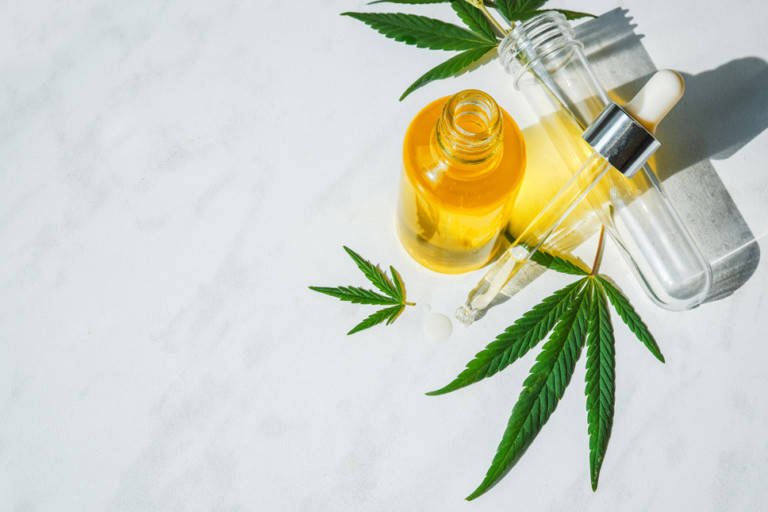
The endocannabinoid system, still new in health sciences, has been the muse for CBD and other products. This area is only going to grow.
Still somewhat dewy fresh in the spotlight of human biological systems, the endocannabinoid system (ECS) has been the focus of dramatic product development. After all, its existence was discovered only 30 or so years ago. The ECS is thus named as it was revealed by researchers who were exploring the myriad biological effects of compounds in cannabis.
The ECS exists in all humans—even without the use of cannabis products. The system, composed of endocannabinoids (which are produced naturally in the body, hence the prefix “endo”), receptors and enzymes—regulate a range of processes such as mood, memory, appetite, digestion, sleep, stress reaction, chronic pain, inflammation and other immune responses, bone remodeling/growth, muscle and cardiovascular function and fertility. The medical community believes that the primary role of the ECS is to maintain homeostasis.
The two main endocannabinoids are anandamide (AEA) and 2-arachidonylglyerol (2-AG) that the body makes as needed, and they bind to receptors (CB1 in the central nervous system, and CB2 in peripheral nervous system). AEA tends to bind to CB1 and is known as the “bliss molecule,” while 2-AG binds to both and primarily supports immune functions.
Cannabidiol (CBD) is one of two major cannabinoids occurring in cannabis (the other being tetrahydrocannabinol or THC), and both interact with the ECS. The way in which THC binds to CB1 or CB2 is known, but the way in which CBD exerts its influence on the ECS is still somewhat murky. There is a theory that it acts by preventing the breakdown of endocannabinoids by specific enzymes—fatty acid amide hydrolase and monoacylglycerol (which breaks down AEA) acid lipase (which breaks down 2-AG). Another is that it may interact with receptors in a different manner.
CBD products have bloomed and all signs show that this category will continue to proliferate. Because the main compound is derived from the same species as THC, which is still illegal, there is a murky area that the FDA (U.S. Food and Drug Administration) and DEA (Drug Enforcement Administration) hope to try to clarify.
As of Oct. 1, 2020, the FDA has asserted, “there is a significant interest in the development of therapies and other consumer products derived from cannabis and its components, including CBD. FDA recognizes the potential opportunities that cannabis or cannabis-derived compounds may offer and acknowledges the significant interest in these possibilities. However, FDA is aware that some companies are marketing products containing cannabis and cannabis-derived compounds in ways that violate the Federal Food, Drug and Cosmetic Act (FD&C Act) and that may put the health and safety of consumers at risk.”
Consistent with the Farm Bill language, the DEA considers any product containing more than 0.3 percent THC at any time during the cultivation, harvest, extraction, distillation, manufacturing, distribution, marketing, sales, etc. to be a criminal violation of federal narcotic law. One year later, the FDA nabbed 22 companies for DSHEA (Dietary Supplement Health and Education Act of 1994) violations in manufacturing and marketing their CBD products from oils to supplements, and for kids, people with diseases and even for pets with diseases.
However, any product category that skyrockets to fame and popularity also brings the bad actors to the wild west show. In 2018, the FDA sent one warning letter to a CBD manufacturer that violated cGMPs (current good manufacturing practice) and released adulterated product.
Products containing CBD (even with the 0.3 percent THC allowable content) are superlatively popular. “Imagine finding a treasure chest buried in your backyard that revealed unexpected wonders. That’s a very flashy way of saying, imagine finally starting to understand the endocannabinoid system, long buried in mainstream medical research, and revealing unexpected wonders,” said Cheryl Myers, chief of scientific affairs and education at EuroPharma, Inc./Terry Naturally (Wisconsin).
Myers explained that the recently revealed ECS is a sophisticated communication and regulation system that affects every bit of the body from the scalp to the toenails; medical science and the natural products industry are just beginning to uncover the medical potential of regulating endocannabinoid receptors in the body. One way to accomplish this goal is by ingesting (or applying) phytocannabinoids, the richest source of which is hemp with over 100 identified. And although hemp’s CBD gets all the glory—there are other phytocannabinoid sources, albeit not as potent, such as clove and echinacea.
In the viewpoint of Grant Rogers, marketing manager, Extract Labs, Colorado, consumers are tired of taking prescriptions and OTC (over-the-counter) medicines to alleviate physical aggravations. “The number one reason we hear from our customers about why they are trying CBD is that they are tired of taking painkillers or trying to avoid starting to take them in the first place,” he related. Whether it is the concern of long-term effects of taking acetominophen regularly or potential addiction tied to use of prescription pain pills, the risks and side effects can be serious. “More and more folks are trying CBD to simply but surely feel well without all of the potential downsides,” he commented.
CBD Consumer Profile
Consumer Reports surveyed more than 4,000 Americans in January 2019 and concluded that at that point, 64 million Americans have tried CBD, or cannabidiol, in the previous 24 months. In her April 11, 2019 article, “CBD Goes Mainstream,” Consumer Reports contributor Lisa L. Gill wrote, “Americans of all ages are using it, too. It’s most popular among people in their 20s, with 40 percent of them saying they have tried CBD. But so have 15 percent of people 60 and older.”
She cited market intelligence from the Brightfield Group, which expects the hemp-derived CBD market to grow to $22 billion by 2022—up from $327 million in 2017. Another report by the Brightfield Group, CBD Consumer Insights, yielded the following about the CBD consumer: 57 percent are male, 42 percent aged 26 to 35, 40 percent single, 40 percent consume CBD five or more times per week, and 69 percent like to use CBD edibles such as gummies and beverages.
According to Management Science Associates Inc. data, the top five reasons why people use CBD are: to address temporary/minor pain (20 percent), for mood, stress and anxiety (20 percent), for chronic discomfort (19 percent), to promote sleep (19 percent), and to relax when alone (18 percent). “While there are many ways that CBD products can be used, the two largest reasons consumers use them are probably for pain and mood, especially anxiety,” said Myers.
Betsy Booren, PhD, senior vice president of regulatory and technical affairs at the Consumer Brands Association, writes that by the end of 2019, approximately 34 percent of Americans purchased a CBD product. She noted that this market is “poised for explosive growth.” Another point she provided in her Dec. 11 blog article (“Who is the American CBD Consumer?” on www.consumberbrandsassociation.org) is that those who use CBD are more than twice as likely to believe that CBD use is safe (86 percent) compared to 42 percent of non-users, who are more skeptical.
In March 2020, the Brightfield Group released a survey of 2,638 CBD consumers, finding that 37 percent of them planned to use CBD more frequently, and 47 percent of those Generation Z and Millennial CBD consumers said they planned on doing so.
Older Americans are taking the biggest interest in CBD, observed Rogers. He has found that many will have some initial reservations about CBD as they grew up in the “war on drugs, cannabis is a sin” era. “Retailers can assuage this group by making them feel comfortable and answer their questions honestly. Don’t just try to sell them a product, help them feel like what they are doing is as normal as buying a candy bar. Break the stigma in their minds,” he advised.
Don L. Summerfield, co-founder and vice president of integrative medicine, Colorado-based Pharmaca, explained that there continues to be plenty of news about CBD, as has been the case for about two years now, and Pharmaca’s customers therefore appear to have a “good level of understanding of the benefits of CBD products. And, of course, we have licensed practitioners in our stores that work hard to help guide any customers who don’t have that understanding through the buying process.”
Tim Hitt of Fiesta Nutrition Center and president of Louisiana Cannabis Retailers Association, both in Monroe, LA, observed that “consumers are really getting a grip on CBD and what it does for the body. There is so much information out there now, just a quick Google search and you have a world of information at your fingertips. The biggest issue is helping them navigate through all of it.”
Nick Beers of Garner’s Natural Life noted that customers seem to clearly be more educated about CBD products now. In the beginning, many people didn’t understand the difference between marijuana and hemp, and this confusion is subsiding. “Many customers come in because someone they know is using a CBD product and it is helping their problems and they come in much more prepared to purchase CBD products.”
That said, there are still some myths floating around in the ether about CBD. Hitt said that some consumers believe that CBD is a cure-all. Beers related that many customers still believe that all CBD is “created equal.” In both cases, consumer education is prioritized to teach the numerous benefits that varied CBD products provide and how different CBD products vary in contents for specific purposes.
The area of CBD products that consumers seem to be seeking out involve relief of anxiety and stress; they want CBD solutions that are not only effective but are safe, and don’t cause them to lose focus, make them drowsy, or other uncomfortable side effects, said Myers. “The factors that existed in 2020 are most likely going to carry over into the next year, so there is opportunity to educate about effective, clinically studied anxiety relief. But I would add that anxiety relief that is easily accessible by a wide customer base is important, too. There are still restrictions in certain jobs about using CBD, and that may prove to be a challenge for the market,” she commented.
Challenges
Every category has its share of challenges, and endocannabinoid support via consumption of CBD products is certainly no exception. Myers said she believes that one of the primary challenges here is “an intensified version of what we see across the board with supplements: how legitimate is the ingredient that’s being touted on the label? The explosion in popularity of CBD products has illustrated this quite well—there is a tremendous opportunity for fraud by less-than-honest players in this game,” she warned.
Additionally, she noted, the category is somewhat convoluted by the legality of CBD and laws that vary from state to state. Hitt agreed, commenting, “Right now the biggest challenge is regulation. The FDA continues to drag its feet on making a decision on which direction it’s going to go. No doubt they are pandering to the pharmaceutical industry.”
On the good side, the association between CBD and “getting high” is a challenge that is being worn down. Beers pointed to the growing understanding of how multi-faceted hemp is and the vast number of goods this one plant may provide (including textiles). “We finally have consumers realizing we aren’t asking them to break the law—that taking these hemp products is legal and without substantial doses of D9THC,” he said.
Another challenge that seems to stand out is the sheer number of competitors in the space. Rogers stated, “The biggest challenge is how crowded the CBD space is. There are countless companies, all claiming they make the best products, have the best ingredients, best results. At the end of the day, consumers want results. Don’t just choose a product because it has beautiful packaging or a trendy name. Check labs, read reviews, measure the company in any way that you possibly can,” he advised.
Summerfield agreed, noting that the CBD category contains too many undifferentiated brands that hinder customers’ decision-making. “There are is also a wide range of pricing among brands for basically the same potency, inconsistent product labeling, a lack of FDA guidance outlining which types of products can contain CBD (and at what dosage), and some localized state enforcement issues,” he added.
BDS Analytics’ Consumer Insights 2019 reported that 56 percent of American adults 21 and over don’t understand the difference between THC and CBD, while 59 percent are confused about the effects of hemp-derived products.
Selections
Europharma/Terry Naturally’s AnxioCalm is a non-CBD botanical product that works on the endocannabinoid system. Myers described, “It is clinically proven to reduce anxiety, increase calm and feeling in control, without sleepiness, impaired judgement, or other unpleasant adverse effects. It is also non-addictive. AnxioCalm features a clinically studied, special concentrated extract of Echinacea angustifolia that is standardized for alkamide content that works in the endocannabinoid system and with cannabinoid receptors to reduce anxiety and stress, much like phytocannabinoids from hemp. However, the alkamides in AnxioCalm are not found in hemp.”
A published study (Phytotherapy Research) of women and men with anxiety, who were assessed using the State-Trait Anxiety Inventory (STAI), took AnxioCalm for one week. “While changes were noticed after only one day of use, benefits continued to improve. In just three days, anxiety levels were significantly lower in both state and trait categories,” she said.
Myers also explained that EPA and DHA are also important in supporting a healthy endocannabinoid system, as they build the “scaffolding” that supports the natural cannabinoids and receptors in the brain and throughout the body. EuroPharma/Terry Naturally’s Vectomega is a salmon extract of omega-3 fatty acids in their bioidentical form. It’s naturally bound to phospholipids (which act as the transport mechanism for the omega-3s but provide strong heart and brain benefits of their own) and provides active peptides (which also provide anxiety-reducing benefits.
Extract Labs’ goal, related Rogers, is to continue to explore what is possible with the cannabis plant. The company manufactures tinctures, topicals, capsules, vapes, bath bombs and even pet products. “All of these products offering differing cannabinoid profiles including CBD, CBG, CBN, CBT, and CBC so far. As we continue to grow, we will continue to expand our offering both for products and cannabinoids,” he summarized.
Some newer products include CarryOn Wellness’ sparkling CBD-infused waters in both grapefruit-flavored Elevate and blueberry-flavored Descend. Elevate is formulated to keep one calm yet sharp and contains 10 mg CBD and choline, while Descend provides relaxation without impairment and includes 20 mg CBD isolate plus L-theanine.
Earlier this year, CBD brand Medterra launched Broad Spectrum Tinctures whole-hemp formulas, available in 2,000 and 1,000 mg strengths and in unflavored, strawberry mint and citrus flavors. Among the cannabinoids in the tinctures are cannabinol and cannabigerol. It also launched benefit-focused gummies—citrus-flavored Stay Alert (CBD, Ginkgo biloba, guarana and green tea extract), Keep Calm in tropical fruit flavor (CBD and L-theanine), and Sleep Tight strawberry (CBD, melatonin, chamomile, 5HTP, lemon balm and passionflower).
There are myriad products for the endocannabinoid system, and in the burgeoning CBD space, which also includes a large number of HBA and topical ointments/balms—and even products for pets’ ECSs.
“To us, CBD is one piece of the great cannabis puzzle. Consumers want to explore everything the plant has to offer,” asserted Rogers. “Giving them a way to try different cannabinoids can yield tremendous results. We think this is only going to keep gaining popularity as time goes on.” VR
For More Information:
CarryOn Wellness, www.carryonwellness.com
EuroPharma/Terry Naturally, www.europharmausa.com
Extract Labs, www.extractlabs.com
Medterra, www.medterracbd.com