



The category of “biotics” continues to grow and generate excitement for the sustained health benefits they provide.
It isn’t a “syn” to beef up your biotics department even if you need to reduce the size of a category lolling in the doldrums. Biotics are hot, especially because they no longer need to be refrigerated and are found in an ever-expanding number of products. For example: Twinings just launched Probiotics+ Lemon and Ginger Tea featuring 250 million CFUs Bacillus coagulans GBI-30 6086 as BC30.
Research from Mordor Intelligence (Probiotics Market Size 2024-2029) finds that the size of the market is estimated to reach approximately $79 billion this year, with growth at 7.53 percent CAGR to arrive at an estimated $113.5 billion.
According to stats from Nutrition Business Journal, between 2017 and 2025, probiotic sales are expected to expand from $1.5 billion to $1.67 billion while prebiotics will grow from $38 million to $210 million. Research from FMCG Gurus shows that 65 percent of global consumers have purchased probiotic products for less than two years, and 67 percent confirmed they would purchase a probiotic.
The International Food Information Council finds that in 2021, 60 percent of consumers said they take probiotics at least once daily. This is good news, but we know it can be better.
“We are still teaching our customers that probiotics offer so much more than regularity support,” said retailer Ramona Billingslea of Betsy’s Health in Houston, TX. Betsy’s Health provides its customers with a wide variety of products in this category under our store brand, including a Mood Formula, a Urinary Formula, multi-strain products of various strengths, a Colon Health formula that is higher in bifidobacterium, and more.
Additionally, she noted, “We also must educate consumers on “newer” information, as more and more is learned about biotic supplements. For example, some customers still think that probiotics need refrigeration to work or that acidophilus alone provides all the support one might need.”
Alex Fryer, director of product marketing with NBPure in Arizona, presented an interesting angle: “The biotic products market is growing rapidly, and many are asking, “Why is now the right time for biotics to become huge?”
He attributes much of the recent growth and category excitement to the “gut-brain-everything axis, which underscores how gut health impacts overall wellness. “This is now accelerated by the viral growth of ‘gut-tok’ communities on social media,” he pointed out. “For many, a healthy gut is now seen as vital as better sleep, more exercise, and even quitting smoking! Awareness of these benefits is spreading quickly, even among market segments that are usually slower to adopt new health trends.”
In agreement is Som Ghatak, PhD, senior director of R&D and nutrition science, MegaFood, New Hampshire, who commented, “With gut health increasingly viewed as essential to holistic wellness, the market offers a wide array of products—from functional beverages and foods to supplements—tailored to cater to consumer needs. There is also an increasing recognition of the gut’s bidirectional communication with other organs via the gut-brain, skin, lungs axes that highlights the potential of biotics to influence overall health including physical and mental well-being.”
Luis Giraldy, director of sales, AST Enzymes & Dynamic Enzymes, California, noted that today’s consumers are well-informed and understand that gut health affects everything from sleep and energy levels to the immune system, skin and mental and emotional well-being. A walk through store aisles shows the popularity and variety of pre-, pro- and postbiotics in soft drinks, supplements, snack foods and beauty products.
Brian Craig, CEO, Texas-based Essential Formulas Inc., explained that the biotic market’s trajectory and expansion is exciting, beyond simply pre- and probiotics—postbiotics are gaining ground and Dr. Ohhira, he stated, is a leader in this segment. “Although Dr. Ohhira pioneered what he termed ‘biogenetic materials’ (postbiotic metabolites) back in the early 1990s, it wasn’t until we reworked our labeling in 2018 when we began to heavily promote the fact that our keystone product, Dr. Ohhira’s Probiotics, was a unique combination of prebiotics, probiotics and postbiotics.”
And, he noted, there remains confusion in the market largely due to several emerging terms such as psychobiotics, tyndallized or heat-killed probiotics and zombie-biotics. “Some of these newer terms are not well-defined,” he commented.
According to Kim Plaza, senior technical advisor, Bio-Kult (ADM Protexin), Florida, postbiotics are defined as “a preparation of inanimate microorganisms and/or their components that confers a health benefit on the host.” Additionally, she observed, some manufacturers are now combining biotics as a way of incorporating as many beneficial ingredients as possible, into one product. “Some of these products are loosely labeled as ‘tribiotics’ combining prebiotics, probiotics and postbiotics. However, there are challenges in aligning products such as these, with scientifically backed evidence. This means that it may take some time for the science to catch up with the product combinations,” she cautioned.
Michael Modjeski, chief commercial officer, California-based Wakunaga of America Co., Ltd. sees synbiotics as a growing trend. “Combining probiotics with prebiotics in one convenient supplement not only increases the effectiveness of the probiotic, it also nourishes the beneficial bacteria that already resides in the gut.”
Spore-forming, soil-based (SBO) probiotics are also appearing on store shelves as these sturdy probiotics are able to survive the digestive tract and manufacturing conditions. “The endospore protects them from heat, cold, pressure and pH extremes, allowing them to withstand production, storage and distribution without refrigeration,” Giraldy explained. “Spore formers are ideal for a wider range of products than most probiotics, including supplements, foods, hot and cold beverages and beauty products.”
Enzyme Trends
“-ase” signifies an enzyme, and there are several that consumers are becoming interested in for their health and wellness.
Daniel Renteria, director marketing innovation, MegaFood, observed that enzymes are a smaller segment than biotics and garnered around $382 million in consumer sales in 2023. This segment is predicted to grow around 4.5 percent for the next few years according to Nutrition Business Journal data. “Although enzymes are a smaller segment in gut health, consumers are open to trying them if positioned in a relevant way. We’ve seen this play out with the recent surge of enzyme-based solutions for bloating, as one example.”
According to Plaza, enzymes betaine hydrochloride for supporting stomach acidity, or lactase for those with difficulty digesting dairy products are of interest.
Modjeski said that consumers are learning about specialty enzymes, such as diamine oxidase, which blocks histamine, or serrapeptase, which breaks down fibrin to reduce inflammation. “Because the use of macronutrient-digestive enzymes amylase (carbs), protease (proteins) and lipase (fats) are relatively easy for consumers to understand, the market is expected to grow at a CAGR of 6.1 percent to reach $3.5 billion by 2033,” he commented.
“Combining enzymes and biotics is the next natural step,” said Giraldy. “Taking biotics with systemic enzymes can provide synergistic benefits by promoting a normal response to inflammation and supporting gut barrier integrity.”
When looking at promoting your enzyme category, Giraldy advised remembering that today, customers have different dietary needs and preferences. Almost 10 percent of the U.S. population is vegan or vegetarian, while 35 million Americans have difficulty digesting lactose, 6 percent are gluten intolerant, and approximately 9 percent of people in the U.S. follow a keto or paleo diet.
Biotic & Enzyme Contenders
To reiterate and paraphrase, biotics have stormed out of the confines of the refrigerator (except when blended into chilled functional beverages). The bevy is exciting, and curating your shelves with the biotic family and enzymes can be a fun exercise.
Dr. Ohhira’s Probiotic products represent a fusion of traditional Japanese fermentation techniques with state-of-the-art manufacturing and quality control practices, according to Craig. The Original formula product starts with fresh fruits, vegetables, mushrooms and seaweed—rich in prebiotic fibers—blended with diverse probiotic strains then fermented together for a minimum of three years. The brand’s Professional formula starts out the same, but then goes through an additional two-year period of fermentation under anaerobic conditions to promote additional growth and postbiotic production. At the end of the multi-year fermentation, the whole matrix of prebiotics, probiotics and postbiotics are encapsulated in a vegetarian soft-gel to “preserve the full-spectrum of biotics.”
MegaFood has three new shelf-stable probiotic solutions leveraging clinically studied strains to provide targeted benefits, noted Ghatak. Two are focused on women’s health including a highly unique Prenatal Probiotic + Prebiotic that delivers a probiotic clinically shown to support the mother’s immune and gut health and baby’s microbiome at birth, vitamin B6 to help reduce nausea, and a plant-based prebiotic to nourish good gut bacteria. “It recently garnered Amazon Choice New Arrival Pick designation,” he added.
For consumers who prefer refrigerated probiotics, Megafood’s MegaFlora is a line that supports gut and immune health with a blend of 14 strains. The line includes products tailored to adults, children and specific needs such as women’s health.
Wakunaga offers numerous probiotic supplements under its Kyo-Dophilus brand, including Pro+ Synbiotic and Kyo-Dophilus Enzyme + Probiotic. Modjeski explained that the foundation for these probiotics is The Friendly Trio—a proprietary blend of Lactobacillus gasseri KS-13, Bifidobacterium bifidum G9-1, and Bifidobacterium longum MM-2. These human strains have been shown in clinical studies to support a healthy gut and immune system. “All strains in our probiotics are DNA verified to ensure the accuracy of the documented strains they contain,” said Modjeski.
The Kyo-Dophilus line also contains Daily Probiotic, Max Probiotic, Multi -I Probiotic, Pro+Synbiotic, Kids Probiotic chewables, Fifty+ Probiotic, and Cran+ Probiotic.
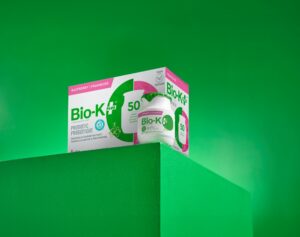
ADM Protexin’s Bio-Kult biotic product range targets different body systems and a variety of microbiomes, according to Plaza. They include Everyday with 14 strains shown to support mood and reduce irritable bowel; extra-strength Boosted which contributes to a healthy immune system and targeted to those taking antibiotics; Infantis sachets for infants and young children, used in numerous clinical trials for infantile colic, atopic dermatitis and antibiotic-associated diarrhea; Candéa to support the vaginal microbiome, used in a clinical trial in bacterial vaginosis; Cyan, which supports the urinary microbiome; Migréa, targeting head pain; and Mind, for cognitive support.
NBPure’s Daily Multi-Fiber combines five types of fiber, including three prebiotics, with four proven probiotic strains to support regularity and overall digestive health, Fryer described. “The constructive collaboration between prebiotics and probiotics is crucial for the ‘gut-everything’ axis and overall wellness as more people learn about the role of the microbiome in releasing antioxidants across the body,” he explained. The company also offers the cheekily named Poobiotics containing five probiotic strains that promote long-term regularity. Fryer said it goes beyond the Daily Multi-Fiber probiotic blend to provide deeper support for IBS-C and IBS-D symptoms.
According to Giraldy, AST Enzymes & Dynamic Enzymes offer several blends of biotics and enzymes targeted toward supporting gut function, to promote immune health and more. Floracor-GI is a synbiotic to support gut-related immune health and microflora balance, intestinal and yeast cleansing. Clean E-Z promotes a healthy gut microbiome, healthy energy levels, intestinal and colon health, and gut and intestinal cleansing. Biome Ultra is another synbiotic formulated to promote immune health, energy levels and a healthy gut. And Biome Ultra (ProbioSEB CSC3) has been studied in combination with ImmunoSEB, a systemic enzyme complex.
“Two clinical trials and a case series showed the pairing of these supplements promoted a reduction in post-viral fatigue and brain fog. Study participants taking the enzyme-probiotic combo had shorter hospital stays, shorter recovery time and a faster reduction in CRP levels,” Giraldy explained.
AST Enzymes & Dynamic Enzymes’ Excellacor is a blend designed to support metabolic, joint and tendon health, muscle recovery, and a healthy response to inflammation, while Serracor-NK is a patent-pending formula to promote cardiovascular health, respiratory health, fibrinolytic health and a healthy response to inflammation. Studies show serrapeptase, contained in both Excellacor and Serracor-NK, “has immense therapeutic applications and promotes anti-inflammatory, anti-biofilm, analgesic, anti-edemic and fibrinolytic effects,” he stated.
Digestive Enzyme Complex, from NB Pure, is a broad-spectrum, 12 enzyme blend for digesting major macronutrients and common hard-to-digest foods. It is a daily mealtime companion that complements the company’s Daily Multi-Fiber, forming a powerful trio of fiber, enzymes and probiotics to support a healthy digestive system. The company’s Enzybiotic features 13 digestive enzymes including specialty enzymes, such as alpha-galactosidase bromelain, and papain to address food intolerances and promote healthy inflammatory responses. It also includes 10 strains of probiotics for IBS symptom relief and inflammation management—ideal for those needing more targeted support than the Digestive Enzyme Complex.
These examples just skim the surface of a large pond of new and exciting biotic and enzyme products. And more are coming. Said Fryer, “The gut health journey is poised for continued growth and innovation. Expect the integration of laxatives, cleanses, proteins, micronutrient powders and antioxidants as part of a comprehensive gut health regimen aimed at long-term wellness.”
Further, he predicted, more outcome-specific biotic/enzyme blends will emerge targeting healthy inflammatory responses, mood regulation, anti-aging and weight management, among others.
Retailer Billingslea enthused, “I look forward to seeing what other innovations our industry comes up with as we learn more about this important category.”VR
For More Information:
AST Enzymes & Dynamic Enzymes, www.astenzymes.com, www.dynamicenzymes.com
Bio-Kult, www.bio-kult.com
Essential Formulas Inc., www.essentialformulas.com
Megafood, https://megafood.com
NB Pure, www.nbpure.com
Wakunaga of America Co., Ltd., www.wakunaga.com