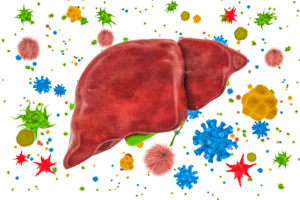




According to a newly published study, examination of stool microbiome can signify if the individual is at risk for development of liver cancer by indicating the presence of non-alcoholic fatty liver disease (NAFLD), a progressive condition affecting approximately 25 percent of the global population. NAFLD is also the leading cause of chronic liver disease that in some cases may lead to liver cancer and liver failure.
In a new study appearing in Cell Metabolism, researchers at University of California San Diego School of Medicine, report that stool microbiomes of individuals with NAFLD are distinct enough to potentially be used to accurately predict which people with NAFLD are at greatest risk for having cirrhosis— the late-stage, irreversible scarring of the liver that often requires eventual organ transplantation.
“The findings represent the possibility of creating an accurate, stool microbiome-based, non-invasive test to identify patients at greatest risk for cirrhosis,” said senior author Rohit Loomba, MD, professor of medicine in the Division of Gastroenterology at UC San Diego School of Medicine and director of its NAFLD Research Center. “Such a diagnostic tool is urgently needed.”
Loomba said a novel aspect of the study is the external validation of gut microbiome signatures of cirrhosis in participant cohorts. “This is one of the first studies to show such a robust external validation of a gut microbiome-based signature across ethnicities [from China and Italy] and geographically distinct cohorts.”
In the latest study, researchers compared the stool microbiomes of 163 participants encompassing patients with NAFLD-cirrhosis, their first-degree relatives and control-patients without NAFLD. Combining metagenomics signatures with participants’ ages and serum albumin levels, the scientists were able to accurately distinguish cirrhosis in participants differing by cause of disease and geography.
The next step, said Loomba, is to establish causality of these gut microbial species or their metabolites in causing cirrhosis, and whether this test can be used and scaled up for clinical use.
Reference:
Oh, TG et al. “A Universal Gut-Microbiome-Derived Signature Predicts Cirrhosis.” Cell Metabolism, 2020; DOI: 10.1016/j.cmet.2020.06.005