

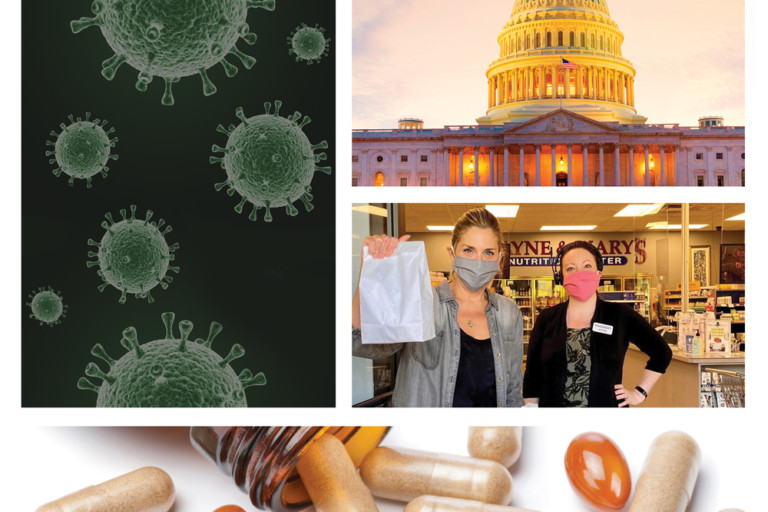
Industry leaders discuss repercussions of the pandemic.
Panelists:
Jim Emme, CEO, NOW Health Group, Bloomingdale, IL, www.nowfoods.com
Jonathan Emord, President, Emord & Associates, Clifton, VA, www.emord.com
Dan Fabricant, PhD, President and CEO, Natural Products Association (NPA), Washington, D.C., www.npanational.org
Jay Jacobowitz, President & Founder, Retail Insights, Brattleboro, VT, www.retailinsights.com
Mark LeDoux, CEO and Chairman, Natural Alternatives International (NAI), Carlsbad, CA, www.nai-online.com
Dan Lifton, CEO, Quality of Life Labs, Purchase, NY, www.qualityoflife.net
Michael McGuffin, President, American Herbal Products Association (AHPA), Silver Spring, MD, www.ahpa.org
Steve Mister, President and CEO, Council for Responsible Nutrition (CRN), Washington, D.C., www.crnusa.org
Len Monheit, CEO, Trust Transparency Center, Spring, TX, www.trusttransparency.com
Marge Roman, Manager, Stay Healthy!, Las Vegas, NV, www.stayhealthylasvegas.com
Marc Ullman, Of Counsel, Rivkin Radler, Uniondale, NY, www.rivkinradler.com
Joe Weiss, President, Nutrition 21, Purchase, NY, www.nutrition21.com
In March, the U.S. DHS (Department of Homeland Security) Cybersecurity & Infrastructure Security Agency (CISA) issued an updated advisory memo listing dietary supplement manufacturing and health-food retail as critical businesses during the COVID-19 pandemic.
While some states have come late to the table regarding the essentialness of health food stores, and some very late (such as Arizona, Colorado and Massachusetts), dietary supplements now appear to be basking in a greater level of respect during this difficult time.
At the same time that dietary supplements are flying off the shelves, unfortunately a number of shady marketers of intravenous (IV) “pandemic kits” and other illegal products, in most cases not even originating with the nutrients’ manufacturers, have rightly drawn the ire of the U.S. Food and Drug Administration (FDA), the Federal Trade Commission (FTC) and of the natural products industry at large.
That being said, it is a time of great opportunity for natural products retailers and manufacturers to “catch the wave” of spiking sales and burgeoning interest by gaining the trust of a wider consumer base with many new consumers.
Our expert panel takes a look at all of these issues.
VR: How did some states get it so wrong regarding the essentiality of health food stores and dietary supplements?
Jacobowitz: There’s a saying in politics: If you don’t have a seat at the table, you are on the menu. We live in a republic and a democracy, with the right of the people to petition its government. Therefore, we must always make our voices heard amid the cacophony of competing interests. I would say, in those states that got it wrong on the essential nature of our business, competing interests to the natural products industry spoke louder than we did.
LeDoux: Good question—one has to consider the political environment that influenced these decisions, because from a logical standpoint, they made no sense in light of the DHS analysis. Roman: My state, Nevada, certainly did [get it wrong]. We were closed by the police department and so we organized a “get us reopened” campaign. Finally, after 1,000 phone calls and e-mails—and even a story on the news—we were allowed to reopen the following afternoon.
Emme: Several states were challenged with these issues early on during the COVID-19 business shutdown process, mainly due to their lack of knowledge regarding the role health food stores and dietary supplements play in supporting the nutritional needs of consumers.
We worked very hard with industry trade groups, especially the NPA, to get resources on the ground in the states to inform the staffs of the governors about the negative impact that would happen if health food stores were declared non-essential.
There is much credit to be given to many governors who listened to us and designated health food stores as essential. We did make some progress in some of the states you’ve listed, yet others still chose to deem these stores non-essential.
The worse-case scenario has been in Nevada, where the state laws give the governor power over the local municipalities in determining these designations. We were unable to get relief in Nevada, yet we were allowed to continue to operate our manufacturing operations located in the Reno-Sparks area.
Fabricant: We unfortunately saw many state and local governments who chose not to follow the guidance set forth by the Department of Homeland Security. Instead, they placed restrictions on businesses. It was imperative that businesses deemed essential such as health-food stores and the manufacturers who supply these products remained open for business during crises such as this. NPA worked with Administration officials to secure specific language in the Department of Homeland Security’s guidance to deem our industry essential. In any health crisis, it is the marginalized people who are most affected, yet these folks are the ones who rely most on nutritional products to support their health and wellness.
Lifton: On the one hand, we don’t want to blame states for trying to be careful, since everyone was caught off guard by this crisis. On the other hand, though, it’s hard to understand why this DHS guidance on essential businesses would be ignored by some states. It fails to compute, for many retailers and consumers, as to why health food stores in some states weren’t considered essential businesses while stores that sell alcohol and cigarettes were.
Emord: Many governors and public health authorities have long harbored an unscientific bias against dietary supplements and health food stores. It should not surprise us, then, that certain of them chose to exclude these stores from their definitions of essential services. That was a profound mistake.
Ullman: In some states, health food stores are still (wrongly) viewed as selling “snake oil” and are penalized because of this. There is no reason that these stores should not be treated as any other food store and the NPA’s immediate response to help correct this type of discrimination has been critical in correcting this kind of error. I’m also aware of more than one situation where a store owner asked permission to stay open even though the initial order clearly stated they could continue to operate as essential business. When you ask an unnecessary question under circumstances like this, you risk getting a bad answer.
VR: Is the number of irresponsible and illegal COVID-19-related bogus claims finally decreasing for shady dietary supplement products?
McGuffin: AHPA guidance always directs the industry to follow the law, and don’t make what we call SDCs (stupid drug claims). It’s really just not wise to make a “cures COVID-19” or “prevents COVID-19” claim. AHPA joined other trade associations in expressing strong support for active enforcement by these federal agencies. It is important that there are controls in place to protect against taking advantage of public health fears.
At the same time, AHPA has analyzed the warning letters and found that, of the first 133 warning letters issues by FDA and FTC, just over 25 percent of those are addressed to companies selling products labeled as dietary supplements.
However, the largest single category has been for intravenous treatment with vitamin C, for example. At least 20 percent of warning letters have been issued to practitioner clinics. We appreciate that FDA and FTC are paying attention, but we find very few instances where it’s a brand of herbal products advertising their herbal product treats, cures or prevents COVID-19. It’s much more likely to be downstream by a practitioner, sometimes by a direct selling marketer, but we see very few claims made by the company that made the product.
Fabricant: In January of this year, NPA was the first association to notify both FDA and FTC about claims to treat or prevent infection by the coronavirus. Both regulatory agencies have continued to police the market and issue warning letters for companies that continue to label products with such outrageous claims. Reputable companies will not make such claims, nor will we associate with those that choose to violate the law by including them on their products.
Mister: We support FDA in taking swift action against companies making deceptive claims and urge prosecution of companies marketing products being promoted with illegal and unsubstantiated prevention or treatment COVID-19 claims.
While there is well-established research demonstrating how dietary supplements can play an important role in supporting health and wellness, CRN continues to urge the industry and consumers to remain vigilant of fraudulent products in the marketplace. Consumers should avoid any supplement that claims to cure, treat or prevent COVID-19 and always talk to their doctor about the most effective use of supplements to promote overall health and wellness.
Roman: I don’t see many shady products. I do get a lot of emails from unknown companies, but I would never consider any product that makes COVID-19 claims.
LeDoux: This is hard to quantify. Unless the government agencies tasked with protection of consumer health are willing to seize products, or assets of miscreant serial offenders, I fear the temptation to make a “quick buck” by selling products with false hopes or illegal marketing statements will continue.
Emord: I believe the FDA, the FTC, certain United States Attorneys, and certain states’ Attorneys General have used the pandemic as an excuse to expand regulatory and legal enforcement against those who make truthful immune enhancement claims. That is an overreach that is casting a pall of censorship over the market and denying consumers information indispensable to the maintenance of good health and the reduction in the risk of co-morbidities. It is state paternalism run riot and is expanding regulation at precisely in the midst of an economic crisis, very unwise and harmful.
Ullman: Sadly, we continue to see warning letters from the FDA and FTC to these products. In order to really deter the criminals that insist on perpetrating this kind of dangerous fraud on the vulnerable public, we will need to see some well-deserved criminal prosecutions and asset forfeiture cases. Why we haven’t seen this happen is inexplicable.
VR: It is reported that supplement sales have been surging during the pandemic, with consumers relying more on dietary supplements to support overall health and immunity. Have the biggest sales mainly been in the area of immunity boosters (like vitamin C, zinc, echinacea and elderberry) or across the board?
Weiss: Nutrition21 has a highly bioavailable form of zinc called Zinmax, which was growing strongly last year and now has experienced explosive growth since the pandemic hit. Consumers are choosing to self-manage their health and well-being with immune support supplements, and zinc has been in the news quite a bit. Additionally, our Chromax chromium picolinate is formulated into high-quality multivitamins which is another area of high growth.
Monheit: There has certainly been a halo effect across multiple supplement categories, but the immediate pandemic impact was felt across immunity, then spreading into general wellness, but also manifesting in stress, sleep, adaptogens and energy—not in a sports sense, but in a restorative sense.
Roman: Our regular sales have remained steady, but we have had a huge increase in immune products. My biggest sales are in vitamin C, vitamin D, zinc, elderberry, silver, NAC (N-Acetyl Cysteine) and hydrogen peroxide. Immune system formulas sell out every time I get them in.
VR: If you are a manufacturer, please give a brief example (or two) of a campaign or promotion that your company has been doing to help consumers during the pandemic?
Emme: Working with our influencer network and brand partners, we’ve shifted our digital content strategy to have more of a focus on self-care, stress management, at-home workouts and recipes. Response has been very positive.
VR: Regarding health-food retailers, industry surveys are reported to show that many natural products businesses that applied for loans under the Paycheck Protection Program (PPP) either weren’t able to submit their applications and many more had them rejected. If known, has this situation improved, or is it a moot point as businesses start to re-open?
Fabricant: I think it’s great that states are beginning to recognize the importance of financial health and are reopening their economies. This is not a moot point as businesses begin to re-open. The federal government did a tremendous job propping up this program as quickly as they did. However, as you mentioned, many in our space were not able to submit applications or were rejected entirely. I hope that as these affected businesses are able to open and operate at full efficiency, whether or not their operations will see minimal impact in the months and years to come will be heavily determined by how quickly local economies recover from the shutdown.
Emme: Our understanding is the situation has improved slightly, yet many states have been delayed by as much as three weeks.
We were fortunate in that our retail stores sell foods as well as supplements, and any store that did so was able to keep their business operating, albeit at a reduced level. We do believe the best remedy is to get businesses open again with the necessary safeguards to protect team members and consumers, which should make the PPP system moot.
VR: For more than 20 years, various bills have been introduced calling for nutritional and dietary supplements to be covered under Health Savings Accounts (HSAs) and Flexible Spending Accounts (FSAs). As Congress and the Internal Revenue Service consider relaxing rules and expanding coverage during the COVID-19 crisis, what concrete steps can the natural products industry take to move the ball forward on this, and how can retailers help?
Mister: CRN is pursuing a two-prong strategy to implement nutritional and dietary supplement coverage under Health Savings Accounts (HSAs) and Flexible Spending Accounts (FSAs). We are both seeking an administrative fix with the Internal Revenue Service (IRS) and continuing discussions with key members of Congress to address the situation in upcoming legislation. CRN, along with the American Herbal Products Association (AHPA), the Consumer Healthcare Products Association (CHPA) and the United Natural Products Alliance (UNPA) recently issued a joint letter to the IRS that offers a clear path forward and exact language needed to address the problem.
CRN has been working to include dietary supplements in FSAs and HSAs for at least 10 years with Congress as a legislative change because we recognize that Congress can overrule an administrative decision, as it did with OTC (over-the-counter) medicine in 2010. We began pursuing an administrative decision last fall, but because of the COVID-19 pandemic, CRN increased its efforts to help provide economic relief for the middle class during these difficult financial times.
CRN will continue its dual approach moving forward to help put more money into the hands of middle-class consumers to help maintain their wellness regimens that include dietary supplements purchases.
Roman: I would love to see supplements covered. Many of my customers are frustrated by the lack of freedom of choice when it comes to how that money can be spent.
Fabricant: Since its inception, tens of millions of Americans have enrolled in an HSA account. In fact, in 2018, there was a 9 percent increase in HSA/CDHP enrollment. This is a tremendous opportunity for consumers to sustain a nutrient rich diet to maintain their health. The natural products industry should continue to champion for policy action to better meet consumer needs. For the longest time, the industry had been handcuffed by provisions in the Affordable Care Act that handicapped over-the-counter products. Thankfully, those provisions have been reversed in the most recent COVID-19 relief package. As an industry we need to signal to our representatives in Washington that this is a voting issue. Together with retailers, we need to call on those we have elected to expand HSAs.
VR: With hundreds of thousands (if not millions) of cars lining up at food distribution locations throughout the U.S. during this pandemic, clearly food insecurity has been shown as a deeply serious problem in this country, possibly more widespread than anyone could have predicted. With this in mind, it’s worth noting that the SNAP (Supplemental Nutrition Assistance Program) Vitamin and Mineral Improvement Act of 2019 was introduced by Senators Tim Scott (R-SC) and Kyrsten Sinema (D-AZ), and Representatives Tony Cárdenas (D-CA) and Mike Rogers (R-AL). Is there a realistic way forward for dietary supplements and SNAP?
Emme: I am an optimist who believes in never giving up on an important issue, and have personally met with the Senators and House Representatives you have listed. They all have been honest and kept their word in regard to the SNAP program for basic supplements. That said, this is a tough hill to climb during a time in which Capitol Hill is trying to work through many other issues, and the SNAP program will be a tougher entrée than the HAS/FSA efforts. We shouldn’t give up on SNAP, and this is another area in which grass roots efforts by retailers can make a great difference.
Roman: Small retailers often don’t even have the software to accept SNAP. We get asked often, but we don’t sell enough eligible items.
Jacobowitz: Remember 1993, and the run-up to DSHEA (Dietary Supplement Health and Education Act of 1994)? Blackout netting over the supplements sections of retail stores, with explanatory signage letting customers know why these products were not for sale. Do we have the same industry cohesiveness today as then? Apparently not. But if not, we are missing leveraging the voice of the American consumer.
VR: Never has online purchasing become more vital and more popular than during the first half of 2020. Amazon alone reported a staggering $75.5 billion in revenue in the first quarter of 2020, up 26 percent from the same period a year ago. Have the structure and fabric of retail been forever changed and, if so, in what ways?
Jacobowitz: Amazon was several weeks out delivering vitamin C while retailers were mostly in-stock. The online delivery genie is not going back in the bottle. So, retailers need to focus on delivering a live interaction and shopping experience that makes visiting their stores worthwhile. It has something to do with remembering the original mission of improving the health of their communities, and reminding those communities, and store employees, of that mission.
Lifton: While the growth of online is certainly not new, convenience has taken on a whole new level of importance, especially with the great expansion in curbside and contact-less delivery. While brick-and-mortar retail is the lifeblood of the health-food industry, consumers now have a whole new set of expectations in terms of convenience, and, once expectations are created, it is unlikely that they will go away. It seems clear that some of these new or expanded retailer-consumer exchanges are here to stay.
Roman: The internet and home delivery have been changing retail for quite a while. I know we will lose some customers, but we have a number of new ones. Our advantage is an educated staff, good inventory control and very competitive prices.
Emme: Yes, the structure has changed. Online sales will be stronger than ever now that many consumers relied on home delivery of basic goods during the COVID-19 shutdown. That said, it appears that the opportunity is ripe for traditional retailers to take advantage of the situation by providing convenience services such as curbside pickups and direct-to-home delivery services.
Many new consumers have been introduced to health food stores during the last several weeks, and retailers have a great opportunity to retain these relationships by being adaptive and creative.
Monheit: New consumers have embraced the online channel, and that’s really the most important takeaway. Some will never go back, others will now be multi-channel users, and some will go back to pre-COVID behavior.
It’s essential to have an online strategy even if in-store is your predominant engagement. As a retailer, building online trust and loyalty has never been more important, and there are so many ways to do just that.
It is interesting to note however that in a recent survey we fielded on shopping behavior, 33 percent of U.S. respondents and 32 percent of U.K. respondents reported no change in their shopping behavior.
Mister: While sales data demonstrate that the recent shifts from consumers will likely affect long-term purchasing behavior, a lot will depend on user experience. If consumers are satisfied with their new virtual shopping experiences, they will most likely continue with those habits in the future. But if they feel like they have lost something, then there’s a higher chance they’ll return to their previous shopping regimens in a post-crisis environment.
Emord: My clients believe a fundamental shift to online purchases has taken place in no small measure because of the health protection afforded through online purchases. While you might believe there would be more reliance on retail once full service is restored, my clients think many will prefer online orders into the indefinite future, consistent with the now accelerated trend away from brick and mortar establishment retail.
VR: In a related question, what will the natural products retail marketplace of 2021 and beyond look like?
Emme: We believe the current product demand environment will continue into 2021. The impact beyond that will be affected by how the ongoing treatment of COVID-19 is developed. Vaccines or drug therapies to treat the virus could pull back some of the new consumers who sought out immune support supplements during the current period.
But there will always be a core base that will not choose the route of prescription drug solutions, who will likely stay loyal to the use of our products.
Overall, we believe that a new generation of consumers will continue to seek alternative solutions to supporting their health goals based on what they have learned during the pandemic.
VR: What specific steps can health-food retailers, distributors, manufacturers (and even the transport industry) take now to be better prepared for the next pandemic?
Jacobowitz: This pandemic has been a dry run for any future calamities. Those that survived by adapting to it this time will be better prepared next time.
Lifton: While nobody can be 100 percent prepared for a global crisis—by nature, crises are unpredictable and unplanned—all players in the entire supply chain, from retailers to distributors to manufacturers to transport companies must now think of much better ways to rapidly scale up sourcing, manufacturing, inventory and fulfillment capabilities so that the natural products industry will be in a better position in the future.
Fabricant: This is such a unique situation that it was hard to plan for in advance. That said, we must all take note of the issues and make changes accordingly. Our community health food stores are essential businesses during times like these and must remain open, but they can only do this if their supply chain remains intact. Membership in the NPA helps businesses stay abreast of changes and to be flexible in our response. Its intimate knowledge of the regulatory and legislative process have proven consistently to be invaluable. We need to strengthen our network within associations such as NPA to have the network of support that they provided us during this health crisis.
Mister: Dietary supplement manufacturers and ingredient suppliers should focus on preparing their supply chains for any future disruptions and stocking ingredients and products most relevant and sought after during a health crisis. CRN suggests that dietary supplement manufacturers not rely on a single source for critical ingredients, that they acquire alternative suppliers in different countries where possible, and that they consider the possibility of having a domestic producer. If demand exceeds supply, discuss now where you rank in your supplier’s priorities and plan now for those contingencies.
It is also critical that in the case of another pandemic, or in a second wave of COVID-19 that companies continue to increase their quality controls; re-evaluate their analytical methods; upgrade testing methods for incoming ingredients; and ensure they are working with responsible third-party laboratories.
We recognize that during health crises consumers seek products to support their health and wellness, and increased sales can further tax supply chains that are not equipped to handle the growing demand for these products. That is why during these vulnerable moments when FDA is not on its regular patrol, it is vital for companies to triple check their own quality assurance protocols and deliver the highest quality of products to consumers.
Roman: I wish I knew. Widespread panic and misinformation certainly isn’t a solution. Taking back responsibility for our own health and our families’ health should rise to the top of the list.
VR: As citizens and industry members, what natural products-related criteria will you be using to determine which U.S. legislators and other candidates you will be voting for this year? Emme: We have always been active in educating our people on the positions of the candidates. We have an advocacy team in our company which develops a non-partisan scorecard showing the stance that each of the candidates has on issues of concern to our company. We have some of the most politically educated team members of a natural products company. We encourage other companies and retailers to do the same thing.
LeDoux: We need to realize that globalism is essentially dead on arrival for the foreseeable future. There is a willingness to putting American industry and employees first in securing essential supply chains and sourcing metrics. Politicians that do not put American interests first are likely to soon be retired from public service.
VR: What would you like to add?
Roman: I hope our industry keeps emphasizing quality and education. We all saw a lot of new customers during the pandemic, but now we have to work very hard to keep them! VR