

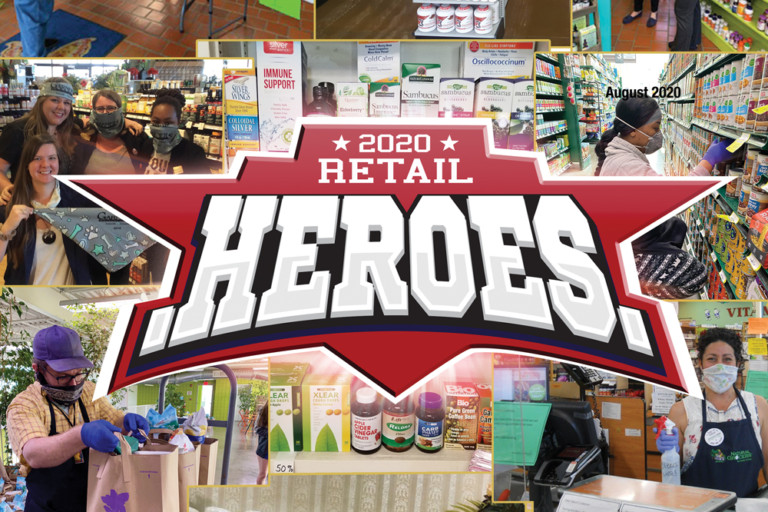
Honoring essential workers of the coronavirus in the natural products industry.
On March 16, 2020, The Natural Products Association (NPA) called for health food stores selling nutritional supplements to remain open during the U.S. government’s response to the novel coronavirus, or COVID-19. The association noted that health food stores offer a wide range of essential products, including, water, electrolytes, nutritional supplements, healthy food options and other health-related products, such as hand sanitizer.
While states created a patchwork of what they deemed “essential” businesses, overall, health food stores were considered part of that group, and their staff members have risen to the challenge of going to work and serving the public during the health crisis—and continue to do so as the coronavirus is still spreading.
So, while considering a single retailer for the annual Retailer of the Year award, the editors of Vitamin Retailer (VR) magazine instead decided to honor all the hard-working retail staff members and stores that are keeping the natural product industry moving forward and meeting the needs of their communities during the pandemic.
From the East Coast to West Coast, retailers across the country told us their stories. So many have taken dramatic steps to try to prevent the spread of the coronavirus. They had to make tough decisions on whether to stay open, how to deal with strained finances and how to keep themselves and their customers safe while providing much needed nutrition and comfort. We consider them true heroes.
Initial Panic
At the beginning of the pandemic, “it was dicey,” admitted Adam Stark, co-owner, with his mother Debra Stark, of Debra’s Natural Gourmet in Concord, MA. “There was a lot of anxiety around this virus, and then, of course, that tidal wave of panic buying hit. [It was] the most frenetic week of retail I’ve ever experienced. And then the anxiety set in. Everyone was a little tense. Or, if they weren’t to begin with, it certainly rubbed off from other people.”
Retailer Edward Jones, owner of Nutrition World in Chattanooga, TN said he also saw the panic. “Initially, many in our city and our staff became frozen with fear. Fear of sickness, fear of causing harm to others, fear of violating the city’s ever-changing regulations. I decided very quickly to not allow fear to prevent us from offering our much-needed products of nutritional supplements, healthy foods and information. We have a duty as ambassadors of natural health to stand tall and brave and act with common sense wisdom for all concerned. I believe calmness and fear are very contagious, and I choose the calm path.”
Retailer Pat Sardell, owner of Country Vitamins in Corvallis, OR, said the store had to reduce hours and pare down staff. “One team member has stayed off the schedule due to being more vulnerable to health concerns, and one working off hours to avoid public contact.”
Along with fear came another very practical aspect of staying open during the pandemic—money. “The decision to close versus keeping open was difficult, as the unemployment benefit included an additional $600,” noted Suellen Duga, co-owner of Choice Health in Westfield, MA. “The government subsidy was tempting to all of us, but the group stayed, except one who has severe asthma and to stay would have been quite a health risk.”
Money also helped address a certain unfairness of asking people to work with the public during a pandemic, Stark noted. “Everyone else is sheltering in place, and here’s our awesome staff, exposed to the public, providing service with a smile,” he said. “So, of course, we’ve got to reward them. Both from an ‘employee retention’ perspective, but also, frankly, because they earned it—they continue to earn it.”
Therefore, the store implemented several strategies. “We put some stuff in place, including a pretty generous health leave policy. And then we came to hazard pay. Well, you don’t want to insult someone with 38 cents an hour. At the same time, you don’t want to go broke at $10 an hour.
“So, we took a middle path,” he explained. “We took a percentage of sales. Half of it came from the business, half from the customer. The thing I’m most proud of is how we messaged it to the customer,” explaining that customers were told of the store’s plan on each receipt. “We didn’t apologize for the surcharge. We weren’t ‘hoping’ they’d understand. We put it right out there like something we were proud of, and that they should damn well be proud of to participate in. And they damn well were! Not a single complaint.”
To help with payroll, Retailer Eric Spinner, of Health Haven II in Medford, NJ, said he applied for a PPP (Paycheck Protection Program) loan in order to bring on an extra employee. Staying positive helped, too. “We try to be a beacon of hope for the community, and to assure them that ‘this too shall pass.’”
While most health food stores were considered “essential,” Marge Roman, owner of Stay Healthy! in Las Vegas, NV, had a different experience at the start of the pandemic.
“The governor’s office did close our store as ‘non-essential,’ but we fought back with the help of Natural Product Association, our customers, our state senator and the mayor,” she said. “Many phone calls and emails were sent, and we were reassessed and allowed to reopen the following day.”
Masks and Social Distancing
States—and opinions—have varied wildly on requirements for wearing a mask during the coronavirus, although most retailers who contacted VR said they wear them and have also stepped up their stores’ sanitation protocols.
Ramona Billingslea, with Betsy’s Health Foods in Houston, TX, said all members of the store staff wear face masks. “We have increased our usual cleaning of surfaces and paid even more attention to hand washing than usual. Because we always work where people are often not feeling 100 percent when they come to see us, we are used to being vigilant on personal hygiene.”
And what was unimaginable less than a year ago has become a familiar sight on store floors and at checkout. “We have installed plexiglass barriers at our registers, we have physical distancing markers placed throughout our stores, and our staff wear masks,” said Rosanne Reinartz of Wayne and Mary’s Nutrition Center in Sioux Falls, SD. “Our fantastic staff have been flexible and understanding during uncertain times, and our customers have been very supportive of a local small business such as ours, and we are determined to keep innovating to offer these crucial services in the safest manner we can for the next 50 years.”
With PPE (personal protection equipment) in short supply, one retailer found local and homemade solutions. Raquel Isely with Natural Grocers By Vitamin Cottage in Lakewood, CO noted that before it was mandatory in many places, Natural Grocers started sewing masks so all of its in-store team members could have two. “It was a joint effort between our neighbors, family and crew,” she said.
The store also connected with Colorado distilleries that were making hand sanitizer. “Then our ops and marketing teams bottled it up and sent it out to stores so everyone could have a personal container to carry on shift.”
Another of the store’s COVID-19 practices will continue after the virus passes, Isely added. “We provide free immune-support and stress-busting supplements to crew daily (at their discretion), and this inspired a new tradition that’s here to stay—Wellness Wednesdays. Every week we ‘toast’ to health with an extra ‘shot’ of wellness, which is a rotation of delicious, immune-supporting recipes created by our Nutrition Education team. And we share the ideas with our customers too.”
While established retailers scrambled to adapt to coronavirus needs, one store held its grand opening. Wellness-360 in Troy, OH, opened in June, according to retailer Paige Jennings. “All of our staff have to wear face masks and practice social distancing while taking care of our customers in the midst of the pandemic. We were grateful to open our doors and help those in the community with their health in a time they need it most.”
Another retailer was juggling several more new stores. Michael Bires, owner of the Nutrition Faktory in the Nashville, TN, area, said he opened 12 Nutrition Faktory locations in just 18 months, “and then the coronavirus hit!” Initially, Bires said his focus was on sports nutrition. “Fortunately, we started ‘pivoting’ early this year, putting more emphasis on wellness products and transforming our stores into a well-balanced experience for all consumers.”
Online Shopping, In-store Pickup
In Swainsboro, GA, a retail store staff found a coronavirus shopping solution that gives new meaning to the words “net profit.”
Nora Weigl, owner of Nora’s Herbs for Health, said that early on in the pandemic the staff knew they would have to take measures to better serve their customers in a safe manner. “Since we carry food items, we stayed open but for abbreviated hours. We came up with a plan to have curbside delivery service using a ‘social-distancing net,’ which our customers loved. Many got the laugh they needed when the door opened and they saw one of us with our mask, gloves and their bagged products in our net. We even were told that some came just for the experience of the new innovative delivery.”
Their customers can pay with Venmo, Cash App or they could put the money in the net. Many customers also took advantage of the store’s low-cost shipping and free local delivery. “Trying to help our customers was our daily goal,” Weigl added.
Erin Dalton at Tulsi at the Market In Huntington, WV, said her store staff also had to shift how they thought and operated in a lot of ways, she said. “We are strictly brick and mortar but began putting together an online store, which was originally something we were planning for the end of the year. We shifted to a curbside pickup and local delivery model, especially for immunocompromised or high-risk customers,” she said.
At Betsy’s Health Foods, a system was already in place before the pandemic that allowed customers to order online for mail order and also choose in-store pickup as an option, said Billingslea. “When the pandemic began, we noticed an increase in our online orders, but also an increase in people calling us to place orders for us to mail. We very quickly added the service of doing curbside pickup for our customers, having them call us when they got to the store so we could run their order out to their car. We’ve had a definite increase in in-store pickups, as well as mail orders.”
At Garner’s Natural Life, in Greenville, Columbia and Lexington, SC, in addition to offering curbside service, the store offered special hours for seniors or those with compromised immune issues, according to store owner Candace Garner Newman. In addition, the stores gave hospital workers and first responders 20 percent off the entire store as a thank you.
Garner’s also gave free gallons of Sapha ionized alkaline water to anyone who brought in a container. “We became very creative daily to do everything possible to keep our staff as safe as possible, Newman said. “We listened to how everyone was feeling emotionally and took steps at each of our stores to fit their safety needs. Our team was unbelievably brave and determined to be there for our customers.”
Retailer Amanda Edwards at Mount of Olives Health Foods in Panama City, FL, also acknowledged the store’s hard-working staff—and its considerate customers. “I believe our strongest driving force was being available to and keeping a form of normalcy for our patrons. Being considered an essential business, we were able to maintain normal business hours. Considering the space in our store and the age group that frequents us, we felt it best to implement curbside and mail delivery services in order to maintain everyone’s health. This was very difficult on our staff. Hoping that we grabbed the right supplement or product. At times we had a line of seven or more people, with phone calls nonstop for only two workers.”
Through it all, their customers are understanding and grateful, Edwards added.
Staying Stocked
Early fears of the coronavirus drove essentials off store shelves. A common experience at brick-and-mortar stores was long lines, empty shelves and days of waiting for toilet paper to come back into stock.
“The coronavirus pandemic has been the strangest thing to happen to the business in my lifetime,” said Keirstyn Johnson with Vig’s Health Food & Discount Supplements in Lewison, ID. “With so many people flocking to health food stores to stock up on immune formulas, we are working diligently to keep our shelves stocked. From working longer hours and coming in early, to being on the phone for hours trying to get our hands on essential products.”
That was the biggest challenge, agreed Duga. “We used many different and sometimes unconventional channels to order the products our customers’ were requesting. We made appropriate substitutions when applicable. We were able to keep our store open but reduced inventory and reduced customer traffic has made paying rent and making purchases difficult, but we are still moving forward by very careful purchasing and open communication with our landlord regarding partial rent payments.”
Retailer Eunice Green, owner of Green’s Nutrition in Stockton, CA, noted, “There have been different phases to running the business through the pandemic. In the beginning, there was a lot of fearful, panic buying but things have calmed down a bit.” She added, “The biggest challenge we had was getting all the products that our customers wanted. There were so many out of stocks.”
At the Mustard Seed Natural Market in Watertown, NY, retailer Holly Prugar said the store had to find a balance between high demand for certain items and manufacturer out of stocks. “Many supplement manufacturing companies were experiencing massive delivery delays, as well. We had to constantly check manufacturer inventory in order to ensure we had the products in stock that customers needed.”
Spinner agreed, adding that although they took a proactive approach, staying stocked still posed a challenge.
“We stocked up on immune supportive products (elderberry, vitamin C, olive leaf, colloidal silver, etc.) even to the point that when things were out of stock from distributors, I went to the big box stores and purchased the items to provide to my customers.”
Wealth of Health Natural Market in Idaho Falls, ID, said they didn’t have to make major modifications to their operations, since they already offered free delivery. Their biggest challenge was, and remains, a broken supply chain and items, such as flours, baking mixes, pastas, etc., that are not being delivered by the distributors and manufacturers.
Despite the difficulties, there has been at least one benefit to come from the pandemic, according to Green. “One of the best things about this is that people who have never shopped in a health food store, never taken a supplement and had no interest in natural products are becoming more aware of the value of good nutrition.”
Customer Bonding
The coronavirus has brought the term “social distancing” to the forefront, however the need for connection has become even more prevalent. Edward Jones, owner of Chattanooga, TN Nutrition World, said he saw the importance of maintaining personal connections through the pandemic with customers, as well as staff.
“We made a massive effort to connect with our base of customers through aggressive social media, proper signage, digital signage, radio show and whatever outlets we could find. We continued to put out the message that we are here for the community and also taking proper steps to protect them. I also sat down with each employee and had a heartfelt talk about the challenging moments we were finding ourselves in, and that my commitment was to not lose my business by operating from fear. I strongly but kindly asked each employee if they were on my team and had my back, or if they could not find that within them at this time to be honest with me and stay home. Strong leadership has never been more important than during the past three months and I have been operating my store since 1979.”
Betsy’s Health Foods also addressed that need. “One thing we’re doing that I think is kind of neat is that our matriarch, Betsy, who is almost 80, is making herself available on the sales floor by FaceTiming with customers who need to talk to her,” said Billingslea. “Between Betsy and the staff members physically at the store, we are able to do something that much more for our customers in a very trying time.”
Susanne Engelbert, co-owner of Eterna Health Food Store in Mansfield, TX, found that laughter was a good “natural remedy” to help get through tough times and connect to customers. “We have worked hard to find genuine, creative ways to show empathy and emotionally connect with our customers. We had our husbands build plexiglass barriers for the checkout stands (we posted jokes on the plexiglass to help keep things light and funny), we have different varieties of masks and hand sanitizers for sale, and constantly are cleaning the inside of the store.”
Being nimble and quick to implement sanitizing, distancing indicators, curbside deliveries and mail orders early on was key, agreed Pat Sardell of Country Vitamins in Corvallis, OR. Retailer Kris Wear, owner of World of Nutrition in Nampa, ID, added, “My biggest regret in this whole deal is that we didn’t have an online store for people to shop. It did show me how important my POS (point-of-sale) system is for remembering what my regular customers purchase because it seems like they all rely on us to tell them what they use.”
Foundation of Health
Natural product retailers have had many shared experiences to adapt to the pandemic, including a dedication to their staff and communities, and in the process, rediscovered their core mission as a business.
Jacquie Fazekas, owner of Bama Health in West Birmingham, AL, said during the pandemic, the staff has worked diligently to be sure their community is getting quality care and quality nourishment. They also have been sending out care packages to those in need.
“These guys are 150 percent in it for their community,” she said. “It is a beautiful thing to witness this store and the people that run it bloom in this community that has been largely forgotten by Birmingham. They are truly swimming upstream against odds.”
Isely added that Natural Grocers has adapted its operations to fit the demands of this crisis in many different ways, from extensive sanitization and social distancing protocols to special shopping hours reserved for seniors and at-risk customers.
“Through it all, we’ve been inspired by our incredible crew, by the support of our neighbors and by the strength of our extended Natural Grocers family taking care of each other,” she said. “Our story is about the truth we’ve always lived by—that helping one another build a strong foundation for health is the most empowering thing we can do, in the best and the worst of times.” VR